

Quick Answer
Mr. R set a strict budget of $1.4 million for a 3-bedroom condo. He ended up paying $1.48 million at Parc Botannia (TOP 2022). It was still the right call — the project entered its peak appreciation window at year three of his five-year hold, the seller was genuinely motivated, and every number held up under scrutiny. Here is the full analysis.
Introduction
Most buyers come in wanting validation. Mr. R came in wanting the analysis to hold up.
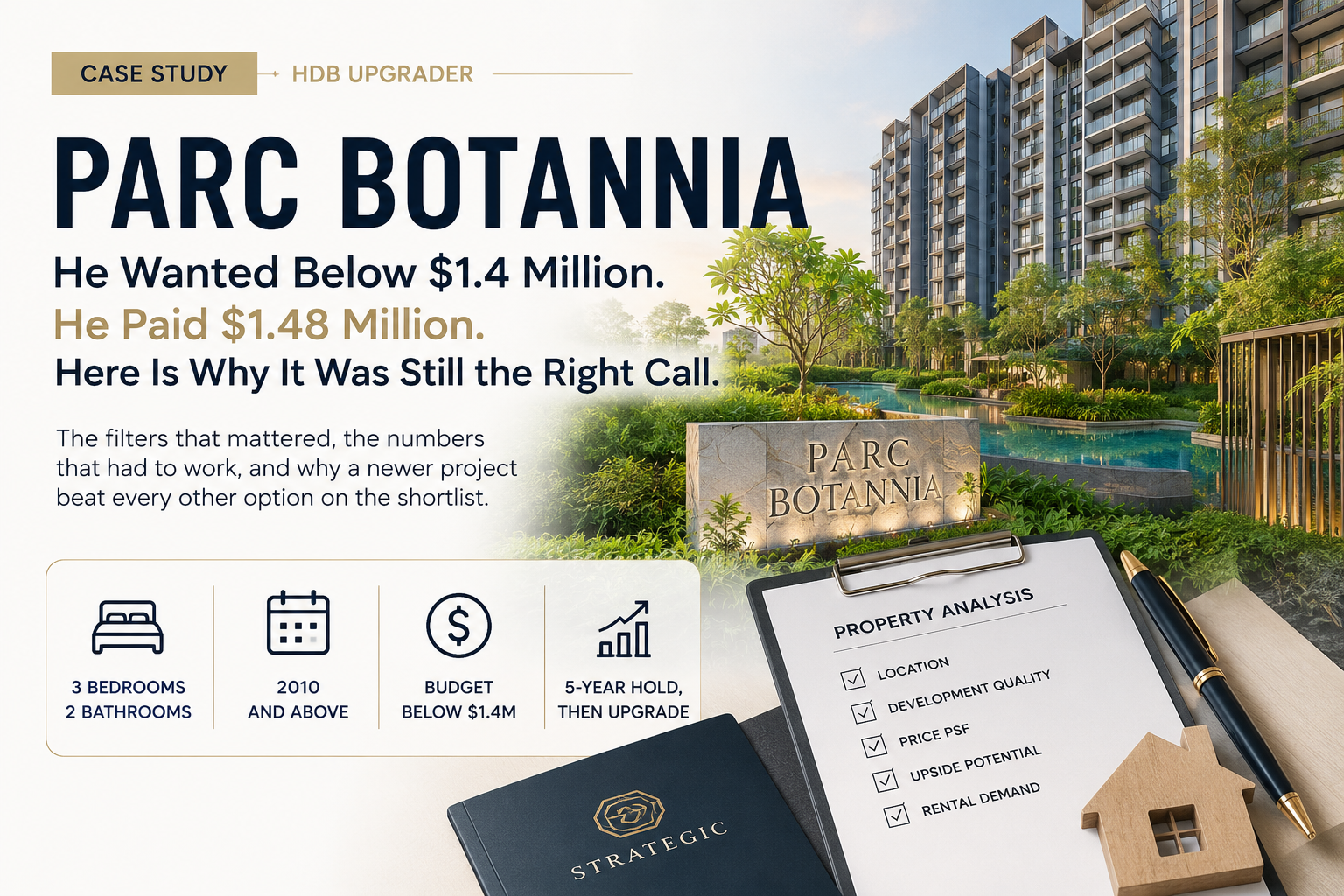
He had already set his own filters before we spoke. Budget hard below $1.4 million. Three bedrooms, two bathrooms. 2010 and above. Five-year hold, then upgrade. He was not asking me to tell him what he wanted to hear. He was asking me to tell him if he was wrong.
That kind of buyer is actually the easiest to serve well. The numbers either work or they do not. When they do, you move. When they do not, you know exactly why.
What Was Mr. R Actually Trying to Do?
Before we looked at a single unit, I needed to understand his real objective. Not just the budget. The exit thesis.
This matters more than most buyers realise. The unit you buy for a two-person household on a five-year hold is a completely different decision from the unit you buy for a family that plans to stay fifteen years. Same budget. Completely different answer.
Here is where Mr. R's priorities landed:
| Priority | Detail |
|---|---|
| Budget | Strictly below $1.4M — bought at $1.48M |
| Unit type | 3 bedroom, 2 bathroom |
| Household | Husband and wife only |
| Own-stay vs investment | 7 out of 10 own-stay weighted |
| Project age filter | 2010 and above, newer preferred |
| Location | Open to anywhere in Singapore |
| Exit horizon | 5 years max, then upgrade |
The 7/10 own-stay weighting tells you something important. This is primarily a home. Layout, natural light, the feel of the unit — that stuff matters. But it is not a forever home. Which means the exit has to be clean. The appreciation has to be real. And the next buyer pool, five years from now, has to be wide enough to transact at a good price without waiting.
The real question is not: do I like this unit? The question is: who will want to buy this from me in 2031, and at what price?
Why Did the 2010-and-Above Filter Matter So Much?
Mr. R came in with this filter already set. I agreed with it immediately.
A 99-year leasehold condo in Singapore does not appreciate evenly across its lifespan. There is a predictable pattern:
- Years 0 to 3: Soft. Multiple sellers enter simultaneously at TOP. Price momentum is slow.
- Years 3 to 10: Peak window. Project is still new in its competitive set. Appreciation is strongest here.
- Years 10 to 15: Moderate. Growth continues but buyers start comparing against newer options.
- Years 15 and above: Headwinds begin. Bank valuations tighten. Buyer pool narrows. Loan quantum shortens.
Mr. R's five-year hold means he enters at year three of Parc Botannia's life, and exits at year eight. That is the middle of the peak appreciation window. His next buyer, in 2031, is still buying into a project with full loan access, nine years of remaining runway in its strongest growth phase, and no lease decay concerns.
Compare that to buying a 2016 project. Same entry price on paper. But when he sells in five years, that project is thirteen years old. A different conversation with the bank. A narrower buyer pool. More competition from newer projects.
Buy young enough that your buyer, five years from now, is still getting in on a new project. That is the entire thesis in one sentence.
Why Do Engineer-Type Buyers Skip the IPA?
Mr. R had not done his In-Principle Approval when we spoke. This is the single most common gap I see with buyers who are otherwise well-prepared.
Engineer-type buyers are especially prone to this. They do the maths themselves. They are confident in their model. The problem is their model uses inputs that banks do not use.
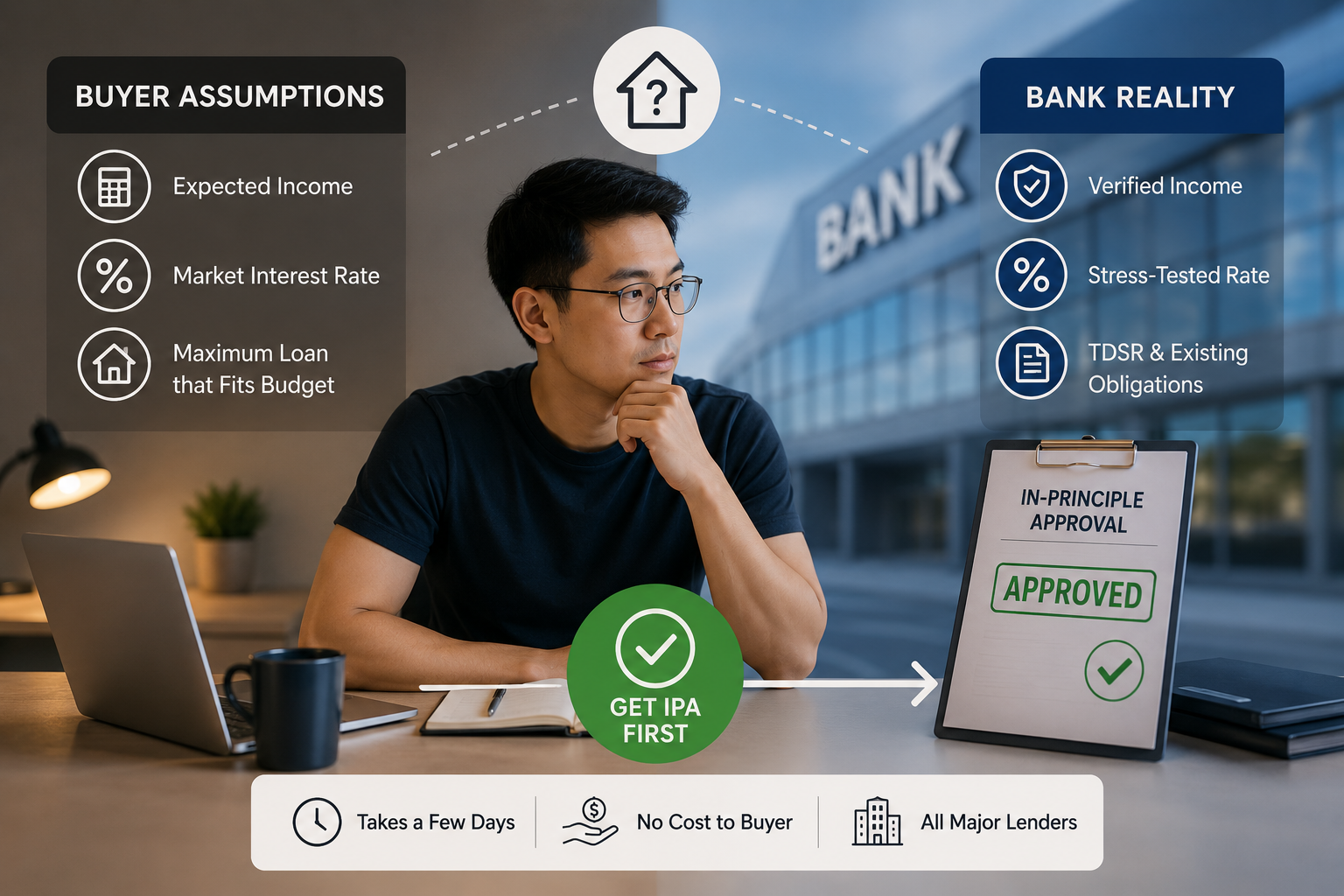
You use your expected income. The bank uses verified income. You use the rate you read about. The bank stress-tests at a higher rate. You assume the loan quantum that makes the budget work. The bank applies TDSR against all your existing obligations.
I had a client earlier this year. Certain his budget was $1.8 million. Online calculators confirmed it. IPA came back at $1.6 million. That is a $200,000 gap — enough to eliminate entire project categories. He found out after he had already mentally committed to a unit.
Do not be that person. The IPA takes a few days. Our mortgage broker is independent, covers every major lender, and costs the buyer nothing. There is no reason to skip this step.
Mr. R completed his IPA before we started seriously shortlisting. That single decision changed the quality of everything that followed.
What Does It Actually Cost to Close at $1.48 Million?
Here is what it costs to close a $1.48 million condo before the bank loan kicks in. These are the numbers most buyers only see for the first time at the lawyer's office. That is too late.
| Cost item | Amount |
|---|---|
| Option fee (1%) | $14,800 |
| Exercise fee (4%) | $59,200 |
| Buyer Stamp Duty (~3.3% on $1.48M) | ~$41,040 |
| Legal fees and misc | ~$5,000 (estimated) |
| Total upfront before financing | ~$129,000 to $133,000 |
On the loan side: 75% of $1.48 million is $1.11 million. At 3.3% to 3.6% over 25 years, you are looking at $5,450 to $5,750 a month in mortgage servicing. Add $300 to $400 in maintenance. That is your monthly carry.
To service this comfortably and keep healthy cash reserves outside CPF, you want combined household income of around $12,500 to $13,500 a month. That keeps your TDSR in a healthy band and leaves buffer.
For a two-person household with no kids, this is manageable. No competing school fees, no dependant costs eating into the monthly surplus. That structural advantage is part of why the five-year hold works for Mr. R.
Why Did Parc Botannia Beat High Park Residences?
High Park Residences was the other serious contender. The merits are real: 1,900 units, healthy monthly transaction volume, strong resale reputation, resort-like quality. I have recommended High Park to other clients. It is not a bad project.
But it was not right for Mr. R specifically. Two reasons.
First, High Park TOP'd in 2016. When Mr. R exits in five years, that project is thirteen years old. For a buyer whose entire thesis is a clean five-year exit, that is not where you want to land.
Second, seller pricing at High Park was not aligned with where realistic negotiation could land within his ceiling. The gap between ask and achievable was too wide to close comfortably without overpaying.
Parc Botannia resolved both. TOP 2022. Exit at year eight. Seller who was genuinely motivated and willing to transact at a number the fundamentals supported.
The final price of $1.48 million came in above his $1.4 million ceiling. We had that conversation directly. The question was not: can we get below $1.4 million? The question was: does $1.48 million make sense for this specific project, at this floor level, at this stage of the appreciation curve? The answer was yes.
The right project is not the cheapest one on the shortlist. It is the one where the entry price, the exit profile, and the livability all hold up at the same time.
How Do You Negotiate Without Giving Up Leverage?
Before we went into negotiation mode, I walked Mr. R through the approach I use with every buying client. It starts with one rule.
You need three units you are genuinely willing to buy. Not one favourite and two backups. Three real options.
Here is why this matters. The moment a seller agent senses you are emotionally committed to one unit, the negotiation is over. You are no longer a buyer with options. You are a buyer who is hoping. And hope is expensive.
With three real options, the dynamic changes completely. I go to each seller agent with the same message: I have a ready buyer, I have alternatives, I need your best price by a specific date. That creates urgency on the seller's side without me having to manufacture it.
On the specific unit we targeted, we assessed the seller's situation before making any offer. An empty unit is almost always a better negotiating target. The seller is carrying mortgage costs without rental income. That creates a genuine timeline. We used it.
Poker requires cards. If you are bluffing with a weak hand, the other side finds out. Three real options is not a luxury. It is the minimum requirement for a proper negotiation.
Should You Renovate After Buying a Resale Condo?
This comes up with almost every upgrader and the answer is always the same. Keep it minimal. Keep it intentional. Do not spend money you cannot get back.
The next buyer does not pay for your renovation. They pay the market rate for that unit type, on that floor, adjusted for condition. A $100,000 renovation might make the unit genuinely beautiful. The buyer in 2031 will still offer based on what comparable units transacted at, not what you spent.
What you can recover is a clean, well-maintained unit. Fresh paint where needed. Functional fixtures. Neutral finishes. That is it. Everything above that line is personal enjoyment — fine if you want it, but do not confuse it with investment.
For a two-person household with no children, the liveability bar is achievable at a sensible budget. You do not need a full reconfiguration. You need the place to feel like yours. That should not cost anywhere near what some renovation quotes in Singapore will tell you it costs.
Verified Transaction
This transaction is based on an actual completed purchase by our client.
Below is the official CEA transaction record showing the completed purchase at Parc Botannia.
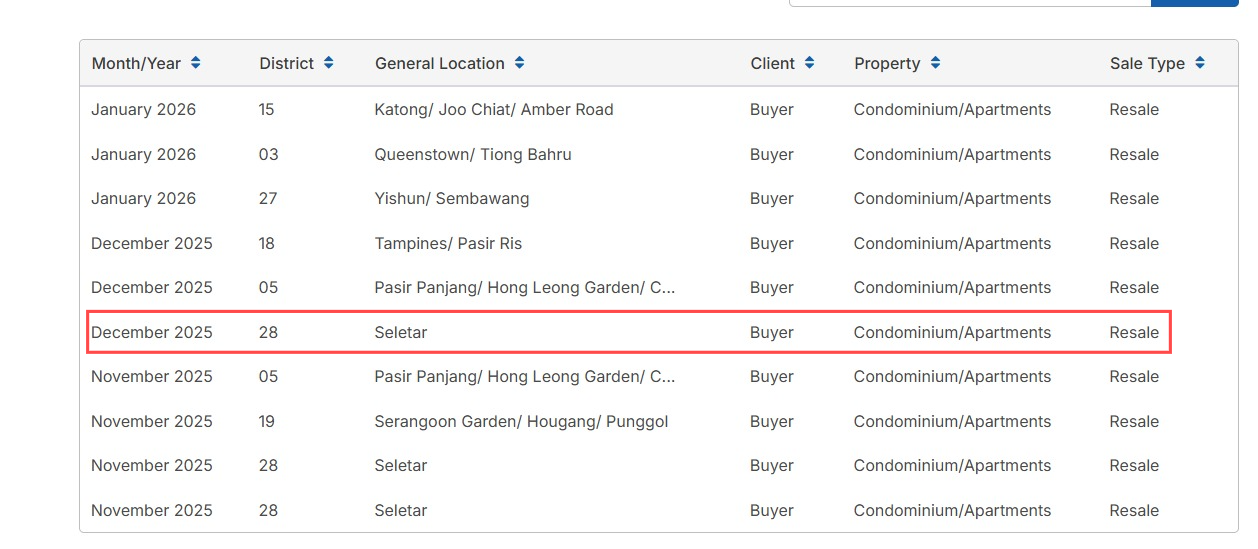
Official CEA transaction record for the Parc Botannia purchase. Client's personal information has been redacted for privacy.
What Does the 2026 Market Mean for Buyers at This Price Point?
The market in 2026 is nuanced. HDB resale prices have moderated. The equity most upgraders built during 2019 to 2023 is largely intact, but it is not compounding the way it was. The urgency of the 2021 peak is gone.
On the private side, URA data shows prices still trending upward at around 2.3% annually. That means the gap between what you net from your HDB and what a private unit costs is widening every quarter you wait. For a buyer with a hard ceiling like Mr. R, that matters more than it does for someone with more flexibility.
New launch supply is also down about 30% versus 2025. Fewer launches means less competitive pressure on developers, which makes well-priced resale in established projects look relatively more attractive. A newer resale unit, negotiated properly, often beats a new launch at current developer pricing.
The buyers doing well right now are not the ones who timed the market. They are the ones who had their foundation in order, knew what they were looking for, and moved with conviction when the right unit appeared.
Mr. R had all three. That is why the deal made sense.
How HomeUp Approaches This
At HomeUp, we do not start with the market view. We start with your numbers.
HDB valuation, IPA, upfront cash, monthly carrying cost, exit thesis — all mapped out before you view a single unit. That is what gives you the clarity to move when the right unit surfaces, instead of second-guessing at the negotiating table.
[Drop us a message at HomeUp →](https://wa.me/6580877015) — we will walk through your upgrade calculation together.
Yeo Tong Boon · Co-Founder, HomeUp
Tong Boon is the Co-Founder of HomeUp, a flat-fee real estate advisory in Singapore. He was featured as an independent property expert on CNA's Open House on 20 June 2026 for his views on the Private Residential Market. He heads the award-winning Champion Private Buying Division in his Agency.
This article reflects his independent views and is not affiliated with the developer or any sales team.
Conclusion
Paying above your budget is not a mistake if the fundamentals support it. Mr. R paid $80,000 above his ceiling and still made the right decision — because the project age, exit profile, and negotiation position all aligned.
The three things that made this work: a clear exit thesis before viewing a single unit, an IPA completed in advance, and three genuine options going into negotiation.
If you are thinking about upgrading at the $1.4 to $1.5 million mark, [start with your upgrade calculation →](https://wa.me/6580877015). The numbers either work or they do not — and it is better to know before you commit.