

Quick Answer
The freehold-vs-99-year landed decision usually comes down to your end goal:
If this is genuinely your final home and you're not chasing appreciation, a 99-year leasehold landed home can make sense. It gets you the landed lifestyle at a lower quantum than freehold.
If you might sell again within 10-20 years, freehold is generally the safer long-term bet. Ageing leasehold landed homes get progressively harder to sell as buyers grow more cautious about diminishing lease value.
Landed buyers are unusually price-savvy. They bargain hard on older leasehold stock, so sellers holding an ageing 99-year landed home can find themselves stuck for a long time if they bought without a clear exit plan.
Some buyers skip an intermediate upgrade entirely and stretch straight to landed, reasoning that a mid-tier condo purchase wouldn't appreciate enough to justify the transaction costs of buying and selling twice.
Introduction

Most landed buyers walk in assuming the freehold-vs-leasehold question is really just a budget question. It isn't, not entirely. The more important question is what this property actually needs to do for you.
I recently spoke with a buyer preparing to sell his HDB and make his first landed purchase, with young kids and ageing parents in the picture. His budget on his own funds sat in the low four millions, stretching higher with family support. He'd been touring a wide mix of options: leasehold clusters, 99-year landed developments, and the odd freehold unit that was well outside budget.
What made his case a useful one to walk through is that he'd already started asking the right question himself: if a mid-tier purchase wouldn't appreciate enough to be worth the hassle, why not stretch straight to landed now? That's exactly the kind of reasoning I want to unpack, because it applies to more buyers than just landed ones.
Why does the freehold-vs-99-year decision come down to one question?
Because the question determines everything else: how much lease decay actually matters to you.
The question I always ask is: is this a long-term plan, or a transition property? A buyer who's genuinely settling in for good has very different priorities from a buyer who might sell again in a decade.
If parents are moving in permanently and this is meant to be the last stop, that's a strong signal it's a long-term hold. If there's still uncertainty, or the property might get sold again once life circumstances shift, that changes what kind of lease profile makes sense to buy into.
Why does an ageing leasehold landed home get harder to sell, not easier?
Because landed buyers are unusually savvy, and lease decay hits harder on landed than most people expect.
A 99-year landed home in its early years, say around 20 years old, still looks tempting: the price feels reasonable next to a comparable freehold, and buyers don't yet feel the lease pressure. But hold that same property for another decade, and it becomes a much harder sell. By then, the remaining lease has shrunk considerably, and landed buyers, who tend to negotiate hard and know the market well, become far less willing to pay anywhere near what a seller expects.
This isn't a small effect. Sellers holding onto an older leasehold landed home can find themselves stuck on the market for a long stretch, regardless of how good their agent is. No amount of marketing fixes a property that buyers have already priced out in their heads. The lesson isn't that 99-year landed is a bad choice. It's that it needs to be a deliberate one, made with a real exit plan or a genuine final-home intention, not just because the entry price looks attractive today.
Who should actually consider 99-year leasehold landed then?
Buyers who are buying the lifestyle, not the appreciation.
The buyers I'd point toward 99-year landed are usually those who want the landed experience once, at a lower quantum than freehold requires, without needing this purchase to be a growth asset. Someone who's already built wealth elsewhere and wants to enjoy landed living as a final chapter fits this profile well. Someone counting on this property to fund a future upgrade or retirement does not.
If you're not sure which camp you're in, that uncertainty itself is useful information. It usually means you're not ready to commit to leasehold landed yet.
Why do some buyers skip a tier entirely and jump straight to landed?
Because the appreciation headroom on the tier below sometimes doesn't justify buying it at all.
Here's the reasoning I've heard from more than one buyer, and it holds up: if a mid-tier property (say, a high-quantum condo) would need to appreciate substantially just to make a future sale worthwhile after transaction costs, why buy it as a stepping stone at all? Every property transaction carries costs: stamp duties, agent fees, moving costs. Doing that twice, once into the mid-tier and again into the final tier, only makes sense if the mid-tier purchase has real room to grow.
If the numbers don't support that growth, stretching directly into the next tier, even if it means a bigger reach today, can work out cheaper overall than the two-step route. This isn't a strategy for everyone. It requires genuine confidence that income can keep pace with the bigger commitment. But it's a legitimate piece of reasoning, and one worth running through deliberately rather than defaulting to "upgrade gradually" simply because that's the conventional path.
What else narrows down landed options fast?
Family logistics, more often than budget.
For buyers planning multi-generational living, a lift becomes close to a hard requirement, which immediately rules out most older landed terraces and a lot of cluster housing. That alone can shrink a wide search down to a handful of newer developments.
It's also worth being cautious with newer landed clusters and townhouses specifically. Some of these developments have surfaced build-quality issues after handover. It's worth going in with eyes open rather than being swept up by a well-staged showflat, since landed purchases carry a much higher price tag for any post-purchase surprises.
One practical habit I recommend before booking a string of viewings: simply drive around the neighbourhood first. It sounds basic, but it filters out a surprising number of options fast, either because the area doesn't feel right, or because it confirms real interest before committing more time.
Practical Framework
Before deciding between freehold and 99-year landed, or between landed and an intermediate upgrade, work through:
Final home or stepping stone? This single answer should drive most of the leasehold-vs-freehold decision.
What's your realistic exit timeline? If you might sell within 10-20 years, weigh how much lease will remain and how that affects buyer appetite at that point.
Does the intermediate tier actually offer enough appreciation room to justify buying and selling twice, after accounting for transaction costs?
What non-negotiable family requirements exist (lift access, proximity to parents, school timing) that narrow the field before price even comes into play?
Have you physically driven around the area before committing to a full viewing schedule?
Is this property tied to your retirement or financial plan? If you're depending on it for future liquidity, exit-ability matters more than if it's simply a lifestyle purchase.
How HomeUp Approaches This
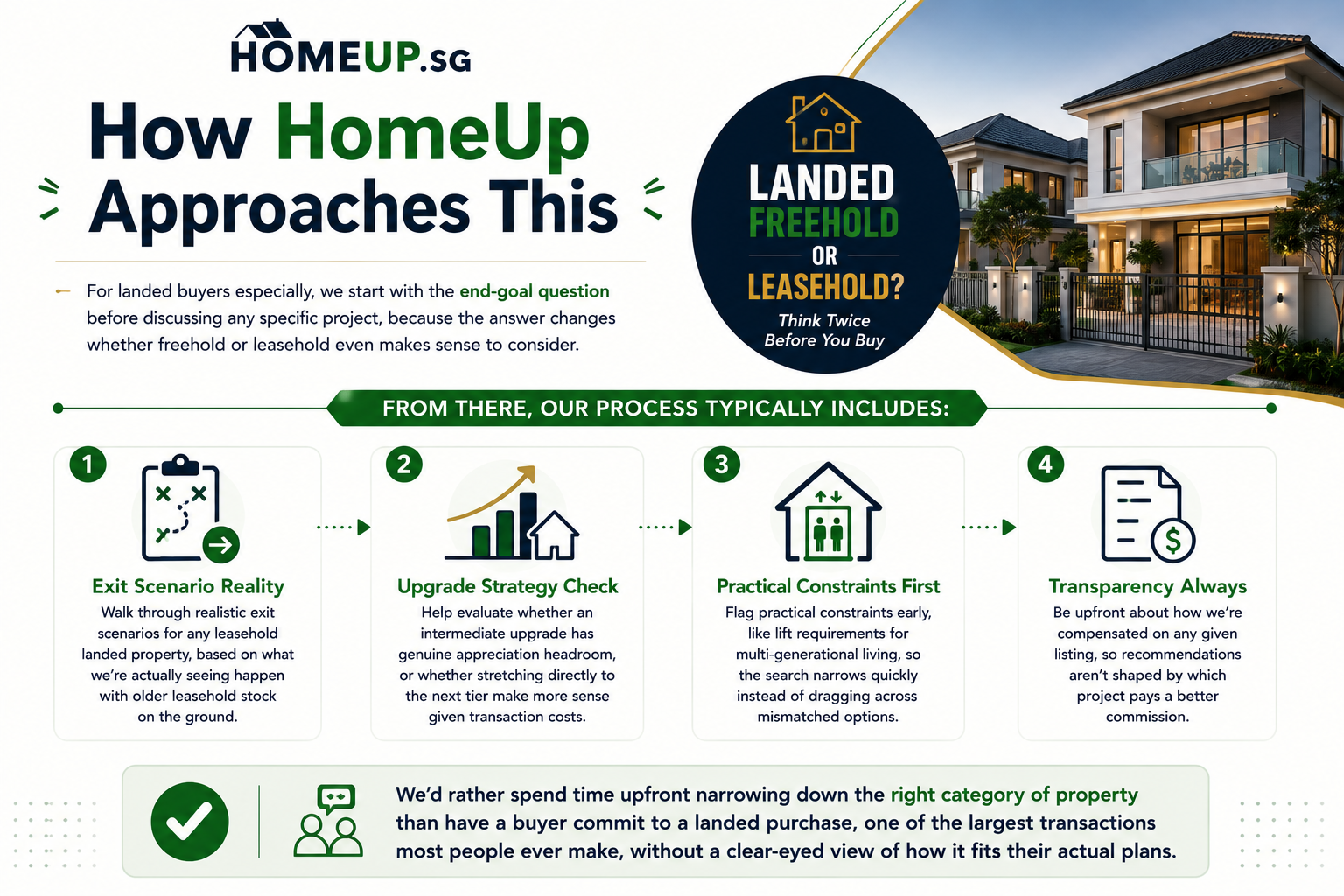
For landed buyers especially, we start with the end-goal question before discussing any specific project, because the answer changes whether freehold or leasehold even makes sense to consider.
From there, our process typically includes:
Walking through realistic exit scenarios for any leasehold landed property under consideration, based on what we're actually seeing happen with older leasehold stock on the ground.
Helping evaluate whether an intermediate upgrade has genuine appreciation headroom, or whether stretching directly to the next tier make more sense given transaction costs.
Flagging practical constraints early, like lift requirements for multi-generational living, so the search narrows quickly instead of dragging across mismatched options.
Being upfront about how we're compensated on any given listing, so recommendations aren't shaped by which project pays a better commission.
We'd rather spend time upfront narrowing down the right category of property than have a buyer commit to a landed purchase, one of the largest transactions most people ever make, without a clear-eyed view of how it fits their actual plans.
Conclusion
There's no universally correct choice between freehold and 99-year leasehold landed, or between upgrading gradually and stretching straight to landed. What matters is being honest about whether this purchase is your final home or another step in a longer journey, and running the numbers on whether an intermediate move actually pays for itself.
Buyers who get clear on that upfront tend to avoid the trap of buying an ageing leasehold property that looked like a bargain, only to discover years later just how much harder it's become to sell.
Tong Boon is the Co-Founder of HomeUp, a flat-fee real estate advisory in Singapore. He was featured as an independent property expert on CNA's Open House for his views on the Private Residential Market. He also heads the award-winning Champion Private Buying Division in his Agency.
This article reflects his independent views and is not affiliated with any developer or sales team. Client names have been changed to protect their privacy.