

Quick Answer
Core Central Region (CCR) property behaves differently from OCR and RCR property because of what actually drives price growth in each:
OCR and RCR growth is largely fuelled by HDB upgraders who sell their flat and buy a condo nearby. That built-in pipeline of local demand doesn't exist in CCR, which has very little HDB stock to begin with.
CCR needs demand to come from outside the area, driven by lifestyle preference, work convenience, or a specific personal reason, not the natural "upgrade in place" pattern.
This means CCR is generally a longer hold, think 15 years or more, rather than a property you buy expecting to flip within a few years.
Freehold units near a wave of upcoming new launches can be a smart entry, because new leasehold projects completing at higher psf can reset the pricing benchmark for the whole area, pulling freehold values up with them.
Introduction

A lot of buyers I speak with assume that prime district property is simply the same market as everywhere else in Singapore, just at a higher price point. It's not quite that simple.
I recently spoke with a couple currently renting, with their move timeline tied to their son starting secondary school in a couple of years. They'd been eyeing a few Core Central Region projects, drawn partly by the idea that the price gap between CCR and the outer regions has narrowed enough that now might be the time to buy in.
That instinct isn't wrong, but it misses an important piece: CCR doesn't grow the same way OCR or RCR does, because the thing that actually drives demand in each region is fundamentally different. That's the conversation worth having before anyone commits to a district based on prestige or a narrowing price gap alone.
Why doesn't CCR grow the same way the rest of the market does?
Because most of Singapore's price growth outside CCR is fuelled by a very specific, repeatable pattern: HDB upgraders staying local.
When someone sells their HDB flat, a large share of them buy their next home in the same general area, often because that's where they're used to, where their social circle is, or simply because it's convenient. In a town with a large HDB base, this creates a steady, built-in stream of local upgraders feeding condo demand nearby. That demand pipeline is a big part of why certain OCR and RCR towns with heavy HDB stock have seen strong price growth. Enough of that town's residents cycle through MOP and a portion of them upgrade into condos in the same area, and that sustained local demand pushes prices up over time.
CCR doesn't have this engine, because there's very little HDB stock in the core central districts to begin with. There's no large base of local upgraders feeding demand. Instead, CCR has to attract buyers from outside the area entirely, people choosing it for a specific reason: proximity to work, a lifestyle preference, or something personal that makes the location worth the premium.
Does that mean CCR is a bad place to buy?
Not at all, it just means it's a different kind of bet, suited to a different kind of buyer and timeline.
Because CCR depends on external demand rather than a steady local pipeline, I generally tell buyers to treat it as a long-term hold, think 15 years or more, rather than something you buy expecting to flip in a few years. Short-term CCR purchases carry real risk, because if the specific buyer profile that wants that area isn't actively in the market when you need to sell, you can find yourself waiting a long time for the right match.
I've seen this play out directly. I once helped sell a rare freehold unit in a CCR project surrounded mostly by leasehold developments, and even with genuine scarcity value, it still took well over a year to find a buyer. The area itself was going through a quiet patch, and buyer hesitancy around the surrounding leasehold projects spilled over onto the freehold unit too, even though it stood out on paper. Scarcity helps, but it doesn't override the fact that CCR needs the right buyer to show up, and that can take time.
Negotiations in CCR can also stretch out longer than buyers expect. I've worked deals that took months to close, largely because sellers who bought at a high entry price are often deeply reluctant to sell below what they paid, even when holding costs make that position more expensive than it looks. Coming in prepared for a longer negotiation window, not just a longer holding period, is worth expecting from the start.
Can buying freehold near upcoming new launches actually be a smart move?
Yes, for the right buyer, and this is a strategy worth understanding even if you don't end up using it.
When an area has a wave of new leasehold launches coming, those projects completing at a higher psf can reset what "normal" pricing looks like for the whole neighbourhood. As new benchmarks get set higher, the traditional premium that freehold commands over leasehold can start to look more reasonable to buyers, narrowing the gap and creating room for the freehold unit's value to move up alongside it.
This is a strategy for savvy, patient investors, not a guaranteed play. The freehold unit itself still needs to be one you'd genuinely want to own, since older freehold developments often come with less polished facilities than a brand-new launch. But watching where new supply is landing, and getting into a well-located freehold ahead of that wave completing, is a legitimate way some investors position themselves in areas expected to see real uplift.
Does renting instead of owning change how I should think about new launch versus resale?
It does, and it's worth factoring in.
Buyers who are selling their own home to fund the next purchase usually face real pressure around where to stay during a new launch's construction period, which is part of why I often steer them toward resale. But if you're already renting, that specific pressure mostly doesn't apply. You already have the flexibility of a rental arrangement, so waiting out a new launch's build time is less disruptive than it would be for someone timing a sale-and-move.
That doesn't automatically make new launch the right call. It just removes one of the biggest practical objections that usually rules it out for other buyers, which means the decision can come down more cleanly to project fit, pricing, and your actual timeline.
Practical Framework
Before committing to a district or a project, especially in CCR, work through:
Understand what's actually driving demand in your target area. Is it a local HDB upgrader pipeline, or does it depend on outside buyers with a specific reason to choose that location?
Match your holding horizon to the area's demand pattern. CCR generally needs a longer hold than OCR or RCR.
If considering freehold, check what new supply is coming nearby. A wave of upcoming launches can reset the area's pricing benchmark in your favour.
Factor in your actual living situation, renting versus selling your own home, when weighing new launch against resale.
Get a real loan assessment early, not just a rough estimate, since your actual affordable range can shift the entire shortlist of viable projects
How HomeUp Approaches This
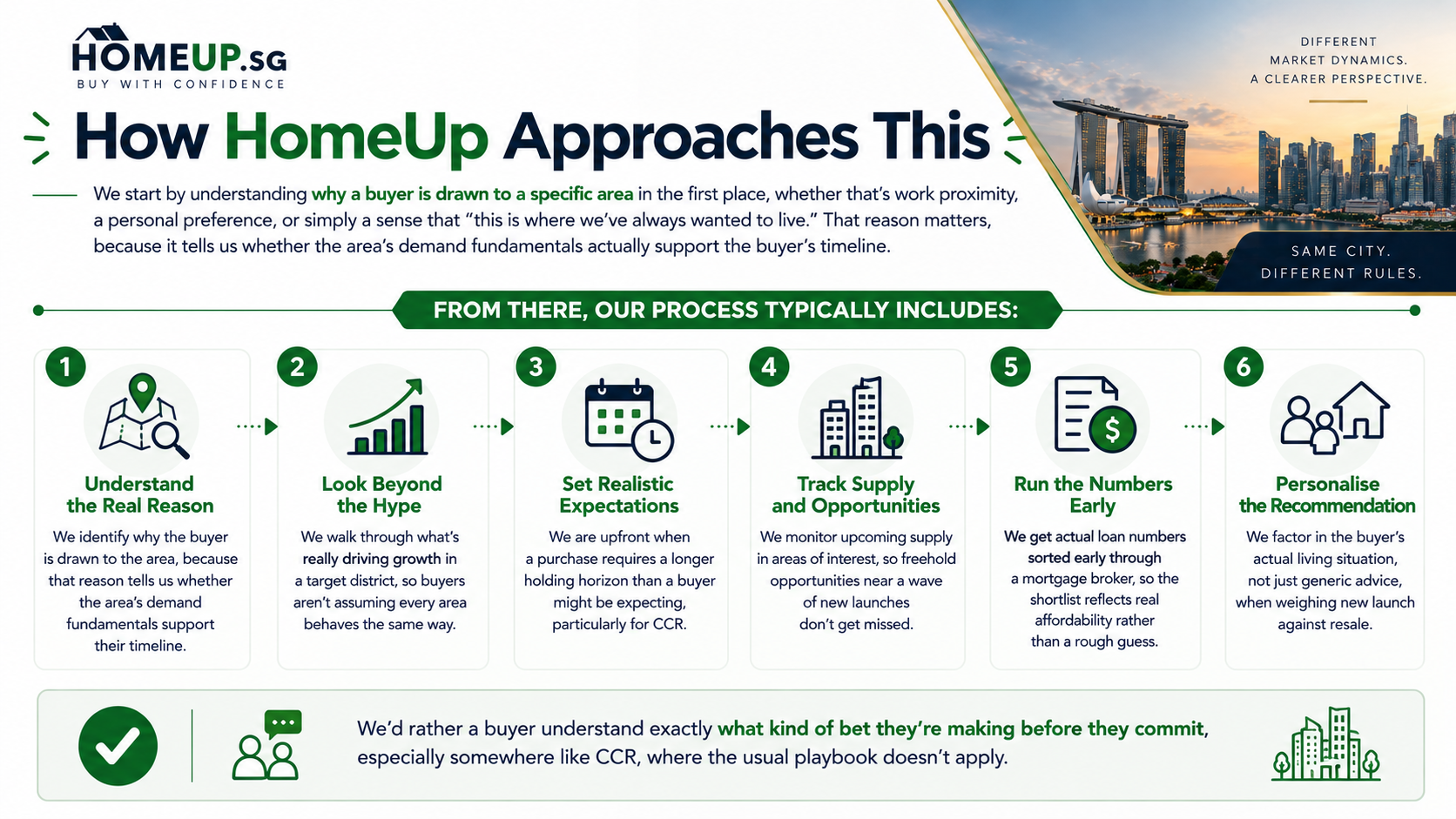
We start by understanding why a buyer is drawn to a specific area in the first place, whether that's work proximity, a personal preference, or simply a sense that "this is where we've always wanted to live." That reason matters, because it tells us whether the area's demand fundamentals actually support the buyer's timeline.
From there, our process typically includes:
Walking through what's really driving growth in a target district, so buyers aren't assuming every area behaves the same way.
Being upfront when a purchase requires a longer holding horizon than a buyer might be expecting, particularly for CCR.
Tracking upcoming supply in areas of interest, so freehold opportunities near a wave of new launches don't get missed.
Getting actual loan numbers sorted early through a mortgage broker, so the shortlist reflects real affordability rather than a rough guess.
Factoring in a buyer's actual living situation, not just generic advice, when weighing new launch against resale.
We'd rather a buyer understand exactly what kind of bet they're making before they commit, especially somewhere like CCR, where the usual playbook doesn't apply.
Conclusion
CCR isn't inherently a better or worse choice than OCR or RCR. It simply runs on a different engine, driven by outside demand rather than a steady local upgrader pipeline, which means it rewards patience and punishes buyers expecting a quick flip. Understanding what actually drives growth in a specific area matters far more than choosing a district based on prestige or a narrowing price gap alone.
Buyers who go in with realistic expectations about timeline, and a clear reason for wanting that specific location, tend to end up far more satisfied with the decision than those chasing the label alone.
Tong Boon is the Co-Founder of HomeUp, a flat-fee real estate advisory in Singapore. He was featured as an independent property expert on CNA's Open House for his views on the Private Residential Market. He also heads the award-winning Champion Private Buying Division in his Agency.
This article reflects his independent views and is not affiliated with any developer or sales team. Client names have been changed to protect their privacy.