

Quick Answer
Paying above valuation isn't always a bad decision, but it depends on the property and your long-term plan.
For this couple, paying $70,000 above valuation for a slow-moving project didn't offer enough upside. Instead of focusing on one unit, they re-evaluated their objectives, shortlisted properties that better matched their future plans, and negotiated from a position of strength.
The lesson? The best purchase isn't always the property you like most, it's the one that aligns with your lifestyle, exit strategy, and financial goals.
Introduction
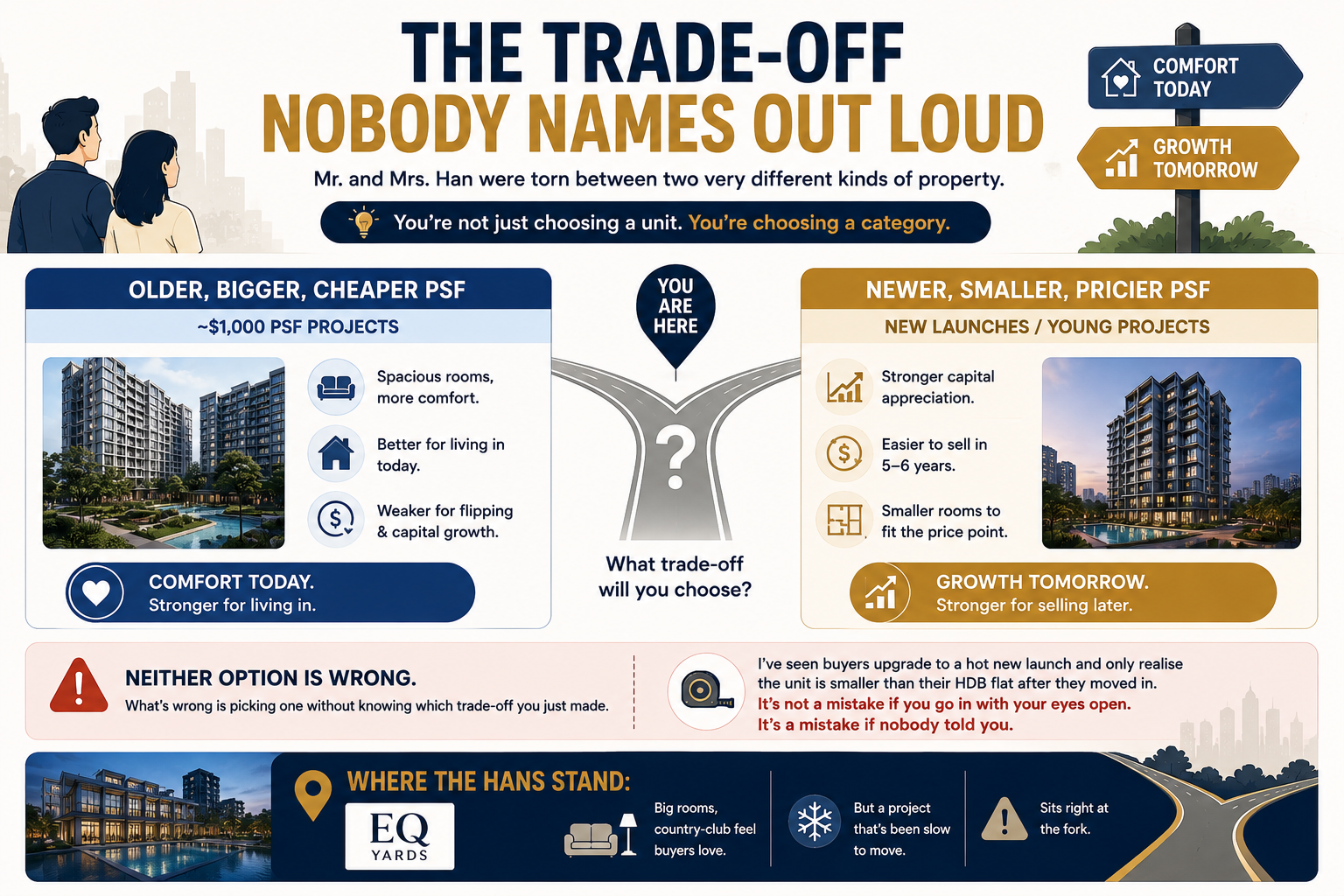
Many HDB upgraders eventually face the same dilemma:
Should you buy a larger resale condo for comfort today, or a newer project with stronger investment potential?
When Mr. and Mrs. Han viewed a condo at EQ Yards, they liked the unit but weren't convinced the asking price represented good value.
Instead of deciding based on emotions, they reviewed the numbers, compared alternative projects, and asked one important question that completely changed their shortlist.
Their experience highlights why choosing the right property is often less about finding the perfect unit and more about understanding the trade-offs behind every purchase.
Should you pay significantly above valuation?
It depends on the property's demand.
For projects with strong competition and consistent buyer demand, paying a premium may be reasonable because market activity supports higher prices.
However, for slower-moving projects, paying a large premium can increase the risk of becoming the highest transaction in the development, making future resale more challenging.
In this case, the asking price was around $70,000 above valuation, which was considered too high given the project's market activity.
Is a bigger condo always the better choice?
Not necessarily.
Older developments often offer:
Larger layouts
Lower price per square foot
Better living space
Newer projects generally offer:
Stronger capital appreciation
Easier resale
Modern facilities
The right choice depends on whether your priority is long-term living or future upgrading.
Why compare projects instead of focusing on one unit?
Looking at only one property makes it easier to become emotionally attached.
Comparing multiple projects helps buyers evaluate:
Price versus valuation
Resale demand
Age of the development
Future appreciation potential
Suitability for long-term plans
This approach creates a more objective decision-making process.
What question changed the couple's shortlist?
Instead of asking, "Which condo should we buy?", they asked:
"What is our final home, and is this purchase meant to get us there?"
Once they clarified that this property was a stepping stone rather than their forever home, they ruled out projects that were either:
Too new and too small for comfortable living, or
Too old to offer strong resale potential.
This left a much shorter and more practical shortlist.
Why should buyers always have backup options?
Negotiation is strongest when buyers have alternatives.
Having several suitable units allows buyers to:
Walk away from unreasonable prices.
Avoid emotional decisions.
Test sellers' flexibility.
Negotiate with greater confidence.
When sellers know buyers have other options, negotiations tend to become more balanced.
How HomeUp Approaches This
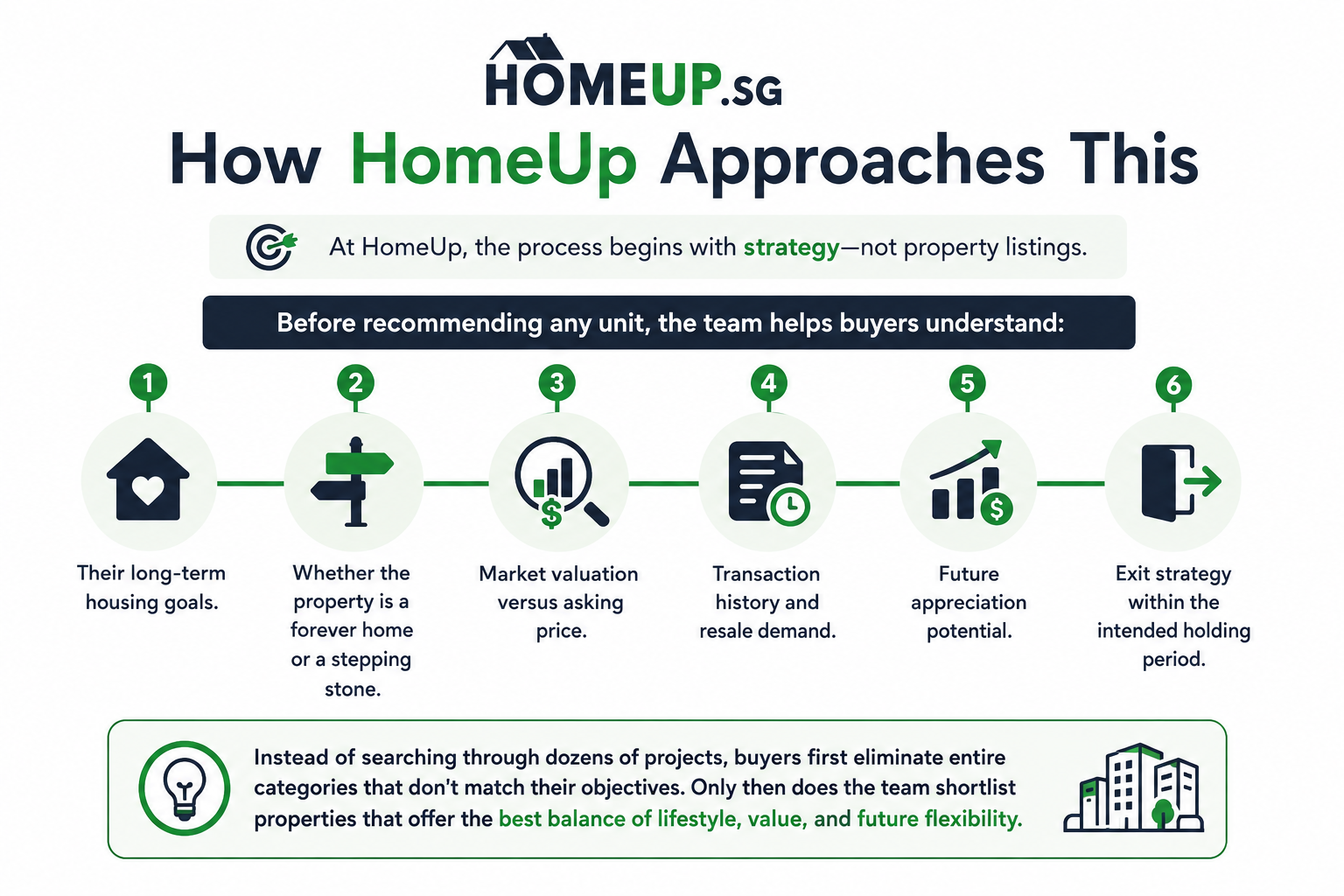
At HomeUp, the process begins with strategy, not property listings.
Before recommending any unit, the team helps buyers understand:
Their long-term housing goals.
Whether the property is a forever home or a stepping stone.
Market valuation versus asking price.
Transaction history and resale demand.
Future appreciation potential.
Exit strategy within the intended holding period.
Instead of searching through dozens of projects, buyers first eliminate entire categories that don't match their objectives. Only then does the team shortlist properties that offer the best balance of lifestyle, value, and future flexibility.
Conclusion
Buying a condo isn't simply about choosing the nicest project.
It's about balancing:
Lifestyle needs.
Budget.
Market value.
Future resale.
Long-term financial goals.
For Mr. and Mrs. Han, stepping back from one attractive listing allowed them to build a smarter shortlist based on data rather than emotion.
Sometimes the best property decision isn't paying more for the one you love, it's finding the one that will continue working for you years after you've moved in.
Tong Boon is the Co-Founder of HomeUp, a flat-fee real estate advisory in Singapore. He was featured as an independent property expert on CNA's Open House for his views on the Private Residential Market. He also heads the award-winning Champion Private Buying Division in his Agency.
This article reflects his independent views and is not affiliated with any developer or sales team. Client names have been changed to protect their privacy.