

Quick Answer
If your primary reason for upgrading is appreciation not space, not schools the question isn't just resale vs new launch. It's whether to:
Combine your funds into one larger, better-located property, or
Split your budget across two smaller units
Some things to weigh:
Quantum resistance points exist. Properties crossing certain price thresholds (a common one being around the $3 million mark) tend to see buyer interest thin out, similar to how million-dollar HDB flats attract fewer buyers than sub-$700k ones.
Three-bedroom units open up a bigger buyer pool than two-bedders, because families with two or more children generally can't fit into a two-bedroom this affects your eventual exit, not just your own comfort.
One-bedroom units are usually a hard pass for investment purposes they're consistently harder to sell.
Splitting your budget into two smaller, less ideal units can sometimes underperform one well-chosen, better-located property, even though it feels like diversification.
Introduction

Most upgraders I meet are moving because they've outgrown their flat more kids, ageing parents, a school they want to be near. But every so often, I get a couple where none of that applies. They're not short on space. They just want their capital to appreciate faster than it would sitting in an HDB.
I recently spoke with a couple like this no kids yet, comfortable in their current flat, but clear that if they weren't going to see meaningfully better appreciation from moving, they'd rather just stay put. That single sentence told me everything about how to advise them.
When appreciation is the primary driver, the conversation changes. It's no longer about "does this fit our family" it's about buyer pool, exit liquidity, and how your budget is best deployed. I want to walk through how I think about this, because it's a different set of questions from the usual upgrader conversation.
Why does the appreciation-driven buyer need a different conversation?
Because the property has to justify itself purely on numbers, not on lifestyle or convenience.
When someone tells me the primary objective is appreciation, my first question becomes: are you confident this move outperforms just staying where you are? If the answer isn't a clear yes, there's no reason to sell and incur all the transaction costs and disruption for a lateral move.
This also changes how I approach resale vs new launch. For most upgraders, I lean toward resale roughly 70% of HDB upgraders I've worked with end up there, mainly because they need to move in without a multi-year wait. But for a genuinely appreciation-focused buyer with flexible housing in the interim, new launch stays firmly on the table, because the pricing structure gives everyone the same entry point on day one there's no "buying from someone who already made money off you" dynamic that resale carries.
Neither route has a guaranteed edge. I've seen buyers who went new launch and struggled to exit years later. I've also seen buyers who went resale and did very well. Nobody has a crystal ball here what I can offer is pattern recognition from being on the ground on a large volume of transactions, not a guarantee.
Should you combine your budget into one property, or split it into two?
This is the question I think matters more than resale vs new launch for this type of buyer.
Say your total budget could either buy one solid, well-located unit, or two smaller, more modest ones. My instinct, more often than not, is that one good property beats two mediocre ones.
Here's the logic:
Two smaller or lower-quality units don't necessarily outperform one strong unit. If one of the two ends up in a weaker location or a less desirable layout, it can drag on your overall return or worse, become genuinely difficult to sell when you need to.
A single, better-located property benefits from combined firepower. You can afford a meaningfully better project, floor, or layout than either of the two smaller purchases could get you individually.
The counterargument I hear a lot is buyer pool: a $3 million property is only affordable to a smaller slice of buyers than two separate $1.5 million ones. That's a fair concern, and it's worth taking seriously but I'd push back on it in two ways:
Incomes rise over time. What looks like a resistance point today softens as the market and buyer incomes move up. I've seen units that were considered expensive a decade ago look completely ordinary now.
You don't have to go all the way to $3 million to get the upside. Often a property in the high-$2 million range still gives you meaningfully more room to appreciate than splitting the same total budget into two smaller purchases, without hitting the steepest part of the resistance curve.
This doesn't mean splitting your funds is wrong. It means it needs to be a deliberate choice based on what's actually available in the market at that point in time not a default because it "feels" safer.
Why do quantum and unit size affect your exit more than people expect?
Because affordability drives buyer pool, and buyer pool drives how fast and how well you eventually sell.
I see this pattern clearly on the HDB side too: flats priced under $700,000 typically draw more buyer interest than flats crossing the million-dollar mark, purely because fewer buyers can stretch that far. Condos behave the same way. Certain price thresholds act as psychological and financial resistance points where the pool of interested buyers visibly thins out.
Unit size plays a similar role, in a less obvious way:
Two-bedroom units feel efficient, but they exclude a large slice of the buyer pool specifically, families with more than one child, who typically need at least three bedrooms.
Three-bedroom units cost more upfront, but they open your eventual resale up to a meaningfully bigger pool of buyers, including growing families who have no choice but to look at three-bedders.
One-bedroom units, in my experience, are consistently the hardest to exit. I generally advise against them for anyone thinking about appreciation, unless the plan is to hold and rent indefinitely.
So when you're choosing between "smaller and cheaper" and "slightly bigger and pricier," it's worth thinking past your own comfort and toward who's going to want to buy this from you in five or ten years.
Practical Framework
If your main reason for upgrading is appreciation rather than space, work through this before shortlisting:
Confirm the "why." Is this purchase genuinely expected to outperform staying put, after accounting for transaction costs?
One property or two? Compare a single well-located unit against splitting the same budget don't assume splitting is automatically the safer or better move.
Check quantum resistance points. Understand where buyer interest tends to thin out at your target price range, so you know if you're buying into a thinner pool.
Prioritise unit size for exit, not just for yourselves. A three-bedroom typically reaches a wider resale pool than a two-bedroom, even if you don't need the extra room today.
Avoid one-bedroom units for investment-first purchases.
Weigh resale vs new launch based on housing flexibility, not just on which "feels" like the better investment.
Stay realistic about timing. No one can predict the market with certainty decisions should be based on pattern recognition and current supply, not guarantees.
How HomeUp Approaches This
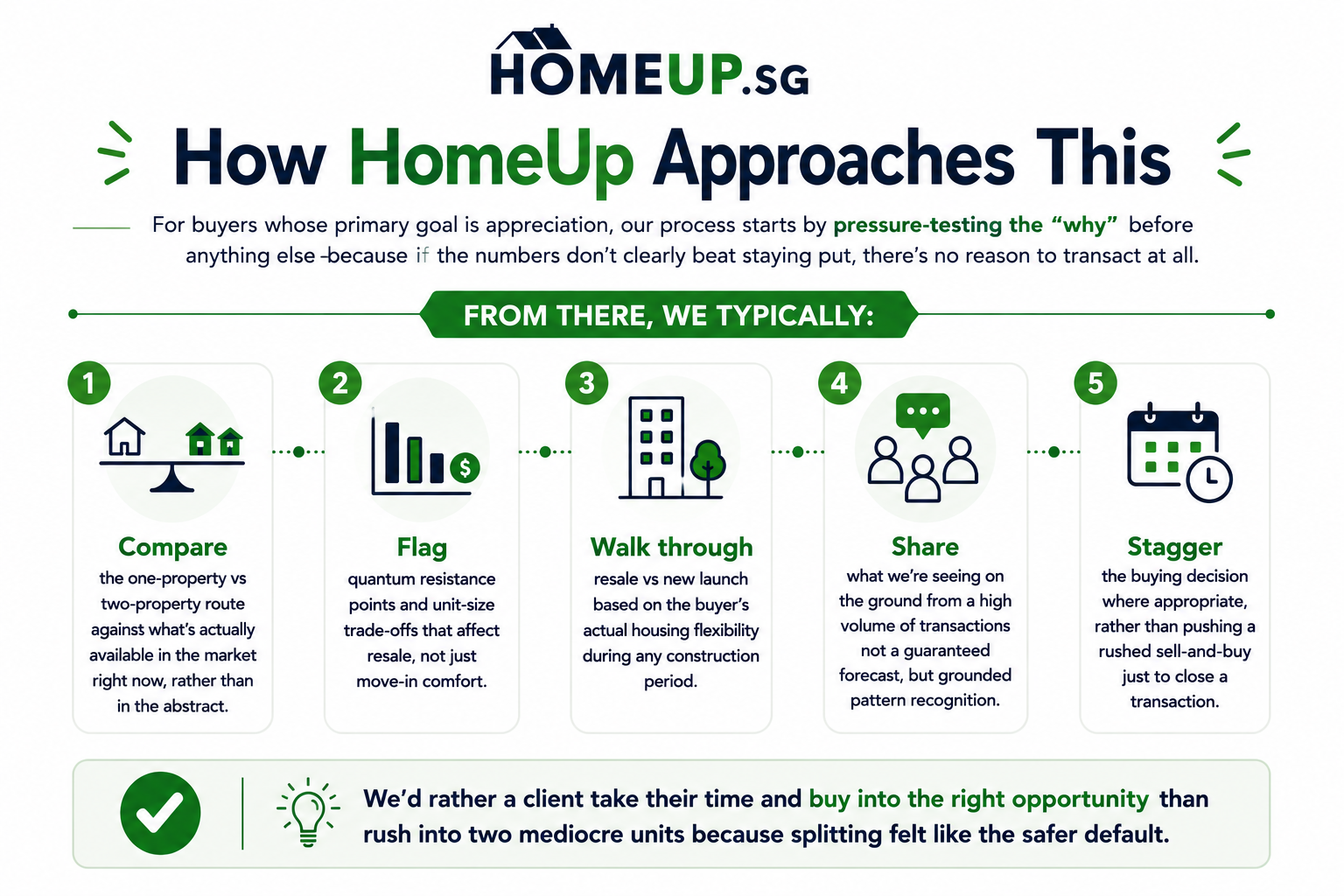
For buyers whose primary goal is appreciation, our process starts by pressure-testing the "why" before anything else because if the numbers don't clearly beat staying put, there's no reason to transact at all.
From there, we typically:
Compare the one-property vs two-property route against what's actually available in the market right now, rather than in the abstract.
Flag quantum resistance points and unit-size trade-offs that affect resale, not just move-in comfort.
Walk through resale vs new launch based on the buyer's actual housing flexibility during any construction period.
Share what we're seeing on the ground from a high volume of transactions not a guaranteed forecast, but grounded pattern recognition.
Stagger the buying decision where appropriate, rather than pushing a rushed sell-and-buy just to close a transaction.
We'd rather a client take their time and buy into the right opportunity than rush into two mediocre units because splitting felt like the safer default.
Conclusion
For appreciation-driven buyers, the real decision isn't just HDB vs condo, or even resale vs new launch. It's whether your budget is better deployed as one strong, well-located property or split across two smaller ones and that answer depends on what's actually available in the market, your quantum comfort, and how much you're willing to trade buyer-pool size for a bigger swing.
There's no guaranteed formula here. What matters is going in with a clear-eyed view of the trade-offs, rather than defaulting to whichever option feels intuitively safer.
Tong Boon is the Co-Founder of HomeUp, a flat-fee real estate advisory in Singapore. He was featured as an independent property expert on CNA's Open House for his views on the Private Residential Market. He also heads the award-winning Champion Private Buying Division in his Agency.
This article reflects his independent views and is not affiliated with any developer or sales team. Client names have been changed to protect their privacy.