

Quick Answer
If you are buying mainly for lifestyle, protect yourself with these steps:
Separate the address you love from the exit you can count on. Projects popular with renters and short-stay residents can show healthy paper gains while very few real buyers turn up.
Check real liquidity, not just the price list. If the same units are still listed three or four months later, buyers hold the negotiating power.
Try renting first. Renting in the area for a year lets you test the lifestyle without committing capital, and you can buy somewhere with better capital growth in the meantime.
Do the budget math early. Your sale proceeds plus your real loan amount decide what size you can afford at central prices. Boutique projects can fit the budget, but they add holding-power risk.
If you are self-employed, get a formal bank assessment early. Online estimates can sit far above what a bank will actually lend.
Introduction

I always tell lifestyle buyers the same thing: wanting a certain feel is a valid reason to buy. A condo is half a place to live and half an investment, and you are allowed to weigh the first half more heavily.
I recently spoke with a couple who wanted exactly that. They had no children at home and no plans for any. They lived in a BTO in the north and wanted to move somewhere more central, with a quieter, more international feel. One of them ran their own business, and they planned to sell the flat for a profit and upgrade. They had a list of places in mind, a few premium, a few at the city fringe, and they were also wondering about an EC.
None of that is unusual. What I wanted them to hear before they spent a cent is that lifestyle and exit are two separate questions, and a lifestyle project can answer the first beautifully and fail the second. That is what this article is about.
Is buying a condo for lifestyle a bad idea?
Not at all. Plenty of buyers are happiest when the home fits how they live.
The risk is not in choosing lifestyle. The risk is in not knowing that you are paying for it. A lifestyle premium is a cost you may not get back when you sell. If you go in knowing that, and you can afford it, you have nothing to apologise for.
What are paper gains, and why do lifestyle projects have them?
Paper gains are the profit that exists only in the price list. They are not the same as the profit you can actually bank.
I recently helped a buyer look at a premium waterfront development with a lovely, quiet feel. The experience inside is genuinely different from most of Singapore. But when I looked at the numbers, the performance was not strong. A lot of units were rented out, and many owners were foreign buyers. The prices on paper kept pace with the surrounding area, but the transactions were thin.
The units that were listed three months earlier were still listed. Four months earlier, still there. When there are many sellers and few buyers, buyers hold all the negotiating power. In a case like that, you can end up selling well below the paper value, depending on how urgently you need to sell. Some owners also have their own reasons to accept less, such as currency movements, and that can pull the price down for everyone else.
I am not saying avoid these projects. I am saying that if you buy one for lifestyle, expect the exit to be harder and slower than the price list suggests.
How can I test a lifestyle location before I buy?
Rent there first.
That is the plan I suggested to a buyer who badly wanted to live in a premium, lifestyle-heavy project. I asked him whether he was at a stage in life where he would not mind selling later at a lower price. He was not sure. So I suggested he buy somewhere with stronger capital growth, and rent in the project he loved for a year.
After a year, you either love it and understand exactly what you are paying for, or you have saved yourself from a purchase you would struggle to exit. Renting costs money, but it is far cheaper than discovering you are stuck. I have been on the selling side of hard-to-sell projects, and a year is not long. Some of those sales have taken years to find one buyer at an acceptable price.
What should I know about boutique projects?
They can be lovely, and they can fit your budget, but holding power matters most.
With a small project, the scariest part is how long you may have to wait for the right buyer. I once handled a listing in a leasehold project of about 50 units, which is small but not tiny, and it was very hard to move. The lease kept ticking down, and new launches kept appearing, which made it worse.
Here is how I think about it. If your final goal is to flip, to go landed, or to buy something much bigger, a boutique project can become a blocker, because you cannot easily exit. If you are happy to stay for a long time, and maybe even keep it later as a rental, a boutique project is more workable. If you do go boutique, freehold is safer than leasehold. The buyer pool for a freehold boutique project tends to be bigger than for a leasehold one. It is still slower than a larger project, but it is better.
What can I actually afford in the centre?
Often less space than people expect. Do the maths before you fall in love with a location.
Here is a simple illustration with rounded numbers. Say your flat sells for about $700,000 and your realistic loan is about $1.6 million. That is roughly a $2.3 million budget. At about $2,300 per square foot, that buys around 1,000 square feet. But if the area you want trades closer to $2,500 to $2,700 per square foot, the same budget buys roughly 850 to 920 square feet.
So you have choices. You can accept a smaller unit in the area you want. You can look slightly further out, in areas that still give you a central feel. Or you can consider a boutique project, with the exit risks above. None of these is wrong, but each has a price, and you should choose it consciously.
It also helps to be clear about your final home. This couple wanted something easy to upkeep, two or at most three bedrooms, and they did not want landed. That clarity narrows the field quickly.
Why does being self-employed change how I plan?
Because a bank may lend you far less than an online calculator suggests.
For this couple, my rough estimate showed a loan close to $2 million. Then I applied their age and a conservative view, and it came down to around $1.6 million. For self-employed buyers, the gap can be even wider, because banks look closely at income history and documents, and at existing credit lines such as credit card loans.
I have seen clients expect a loan of between one and two million and receive about $300,000 less after the formal assessment. That is why I link buyers to a mortgage broker early, before we even talk about selling. You need a bank-confirmed number to know what you can really buy. I am not a financial advisor, and the final numbers always come from the bank.
Is an EC an option?
For a second-timer, it is a long shot, and it may not fit a lifestyle goal.
ECs are often heavily oversubscribed, and second-timers are at a disadvantage in the ballot compared with first-timers. You also need a large amount of cash and CPF at the start, which can be difficult when your current flat has not been sold yet. ECs are often further from the centre, which does not match a buyer who wants a central feel. ECs have their own eligibility rules and payment terms, so check the current details with HDB before deciding.
Practical Framework
Before you commit to a lifestyle purchase, work through this:
Name your reason. Is this lifestyle, investment, or both? Describe your final home in a sentence.
Run the budget math. Sale proceeds plus a realistic loan, divided by the price per square foot in your target area.
Get a formal loan assessment. Especially if you are self-employed or have existing credit lines.
Check real liquidity. How many units are listed, and for how long? Do the prices on paper match real transactions?
Test with rent. Consider renting in the project or area for a year before buying.
Treat boutique projects with care. Prefer freehold, and expect a slower exit.
Decide what you will buy before you sell. If you do not know what you can buy, you may sell your home and have nowhere suitable to go.
How HomeUp Approaches This
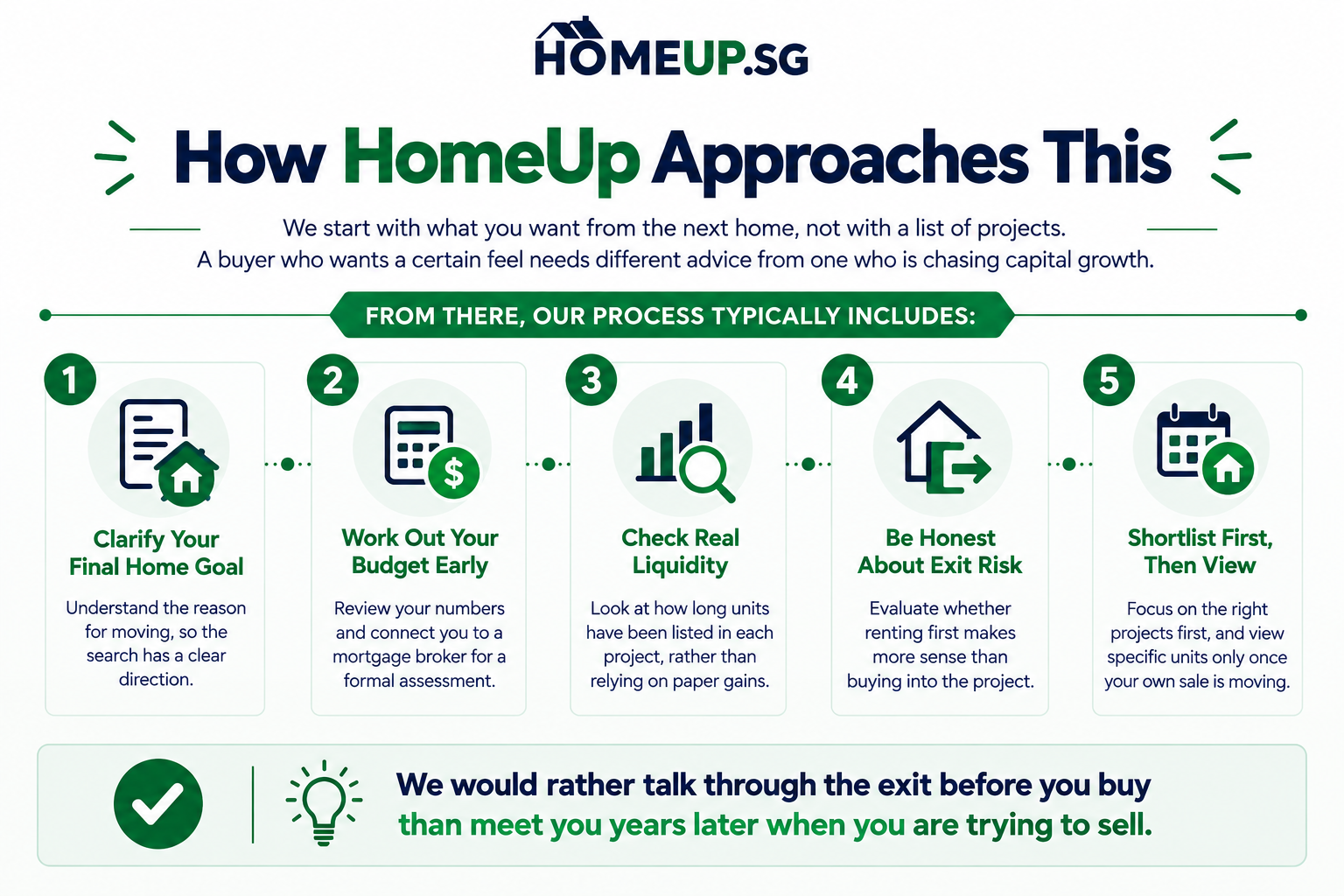
We start with what you want from the next home, not with a list of projects. A buyer who wants a certain feel needs different advice from one who is chasing capital growth.
From there, our process typically includes:
Clarifying the final home and the reason for moving, so the search has a direction.
Working out the budget with you, and connecting you to a mortgage broker for a formal assessment early.
Looking at real liquidity in each project, such as how long units have been listed, rather than relying on paper gains.
Being honest about exit risk, including when renting in a project first is smarter than buying into it.
Shortlisting projects first, and viewing specific units only once your own sale is moving.
We would rather talk through the exit before you buy than meet you years later when you are trying to sell.
Conclusion
Buying for lifestyle is a valid choice, and plenty of people are happy with it. But it works best when you know what you are paying for, you can afford to hold, and you have thought about how you will leave.
Test the lifestyle by renting if you can, check how easily a project really sells, and do the budget math before you commit. A project can feel wonderful to live in and still be difficult to sell, and the buyers who are happiest are the ones who knew that going in.
Tong Boon is the Co-Founder of HomeUp #1 Transactor in Singapore | 2025 (Private Resale, Buyer Represented), a flat-fee real estate advisory in Singapore. He was featured as an independent property expert on CNA's Open House for his views on the Private Residential Market. He also heads the award-winning Champion Private Buying Division in his Agency.
This article reflects his independent views and is not affiliated with any developer or sales team. Client names have been changed to protect their privacy.