

Quick Answer
If you plan to hold a condo for only three to five years:
Buy for the next buyer. Choose a newer project (ideally under about 15 years old), with a good number of units, and a unit size that sells. Your own taste matters less than what the wider market will accept.
New is not free. A brand-new project often carries a hype premium, and sellers tend to anchor high. Around the ten-year mark, sellers are often more reasonable and you have more room to negotiate.
Near-MRT is already priced in. It is valuable, but you may be paying a real premium for it (for example, 100 to 200 dollars per square foot). The MRT effect is also getting more diluted as the network grows.
A new launch sits at the extreme investment end. It only suits buyers who have a place to stay and can accept the risk. Even then, no one can promise it will make money.
Keep cash ready. Plan for roughly 10% of the price in cash upfront, and do not treat a bank valuation as proof that you are paying a fair price.
Introduction

When most buyers tell me they want a condo "for a few years", I ask a simple question: on a scale of one to ten, where one is fully for your own stay and ten is fully for investment, where do you sit?
I recently spoke with a couple who were buying outright, with no property to sell and a place to stay with family for now. They had a budget of around $2 million, wanted the north-east of Singapore, and expected to sell in about four years. One of them did not drive, so being near an MRT station mattered.
Their problem was one I see all the time: they wanted a newer condo, near an MRT, at a price that still left room for profit. Each of those is a good instinct. The difficulty is that everyone else wants the same things, and the market has already priced them in. So the real task is working out which parts you are paying for, and whether they are worth it.
Why is a four-year hold different from a forever home?
Because you are buying for someone else.
When your holding period is short, the question is not "do I love it?" but "who will buy it from me?" A client once brought an older relative along to a new launch showflat. She did not like this, and did not like that. I explained gently that the purchase was for investment, so what mattered was what future buyers would like, not her own niche taste.
A new launch sits right at the investment end of the scale. You do not see the unit for about three years, you are picking the project for return, and you plan to sell after the seller's stamp duty period ends. It is a hit-and-run approach, and it only suits a certain kind of buyer. I have one client who sells a new launch every three years, and he knows the risks. That is rare. Most Singaporeans are on the safer end, even if they think they are not.
You will probably also live in the unit for those four years, and it may even become seven. So your own stay still counts. You are balancing both.
Should I buy a brand-new launch or a slightly older condo?
It depends on whether you can afford to wait, and how much risk you can take.
A new launch only works if you have somewhere to stay. In this couple's case, they did, which makes it possible. But even with over a hundred transactions behind me, I cannot say any project will definitely make money. At best, I would say there is a high chance. If the market turns, you still carry the cost of waiting.
For most buyers who want to live in the unit, I would look at newer resale instead. Here I use a comparison with stocks. A super-new condo is like a growth stock. It is hot, so you pay more. Sellers in a new project often have a "hurt mentality". They do not want to sell below what they feel the project is worth, and I have seen them ask for 30,000 to 40,000 dollars above comparable units. A slightly older condo, around the ten-year mark, is more like a value stock. Sellers are often more reasonable and you face fewer competing buyers, so you have more bargaining power.
Do not chase a hot unit. I recently bid for a client on a three-bedroom with very good facing. Five buyers pushed it to around $100,000 above valuation. We pulled out. It is easy to get caught up when everyone else is bidding, but a good project at a bad price is still a bad deal.
How much is "near MRT" really worth?
Less than most buyers think, and you are probably already paying for it.
A project that is very near an MRT station usually carries a premium that is already priced in. As an illustration, it could be something like 100 to 200 dollars per square foot. So the question is not whether MRT is good. It is whether the price gap is fair.
I have also noticed the MRT effect getting more diluted. The network is better connected, buses help, many people drive, and more will drive electric cars in future. MRT is still important, but it is no longer the single biggest factor it used to be.
There are two practical tests. First, is it really near? A ten to fifteen minute walk is not near, and nobody I know wants to walk that far in the heat. Second, compare the price with a similar project right next to an MRT. If a newer project without MRT is priced well below a comparable one with MRT, that can be a better deal. But if you pay the same price as the near-MRT project, you have lost the protection and the discount at the same time. At exit, you will also face competition from those nearby MRT projects.
At $2 million, should I buy smaller and closer in, or bigger and further out?
This is a crystal-ball question, and the answer comes down to your own stay needs.
At around $2 million, you may get a three-bedroom closer to the centre, or a four-bedroom further out. There are two schools of thought. Buyers with big families often have no choice and go further out for the space. Further-out areas also benefit from steady demand from HDB upgraders, who usually buy back into the area they know. As you go more central, the buyers tend to be more investment-driven.
For a couple of two, a four-bedroom is more than you need, and I would not stretch for it. A good three-bedroom in a project with volume, ideally with a few transactions a month, is a safer choice. Bigger units tend to sell faster than smaller ones, but the size has to fit your life.
Does the bank's valuation tell me what to pay?
No. It tells you what the bank will lend against.
For condos, bank valuations can be quite generous, so a valuation that matches your price is not proof that the price is fair. HDB is much stricter about cash over valuation, because the government wants to control that market. For condos, I would worry less about the valuation and more about whether you are paying a fair price compared to recent transactions in the project and the area. Unless you are paying far above the last transactions, the bank will usually go along with it. That is exactly why you need to do the fair-price check yourself.
Practical Framework
Before you commit to a condo you plan to sell in a few years:
Place yourself on the scale. One is fully own stay, ten is fully investment. Be honest about where you sit.
Buy for the next buyer. Choose a project that the wider market accepts, with volume and a unit size that sells.
Weigh new against around ten years old. Know what hype premium you are paying and how much bargaining power you have.
Price the MRT. Compare with a similar near-MRT project, and check the real walking distance.
Check transaction volume. A few transactions a month help to support prices and make exit easier.
Do not chase a bidding war. Set your fair price first and be willing to walk away.
Keep about 10% in cash. For the option and exercise fees, stamp duty and lawyer fees. Check the details with your lawyer.
Build in holding power. If you enter too high, you may face a dip of a few months when you want to exit, so be ready to wait.
How HomeUp Approaches This
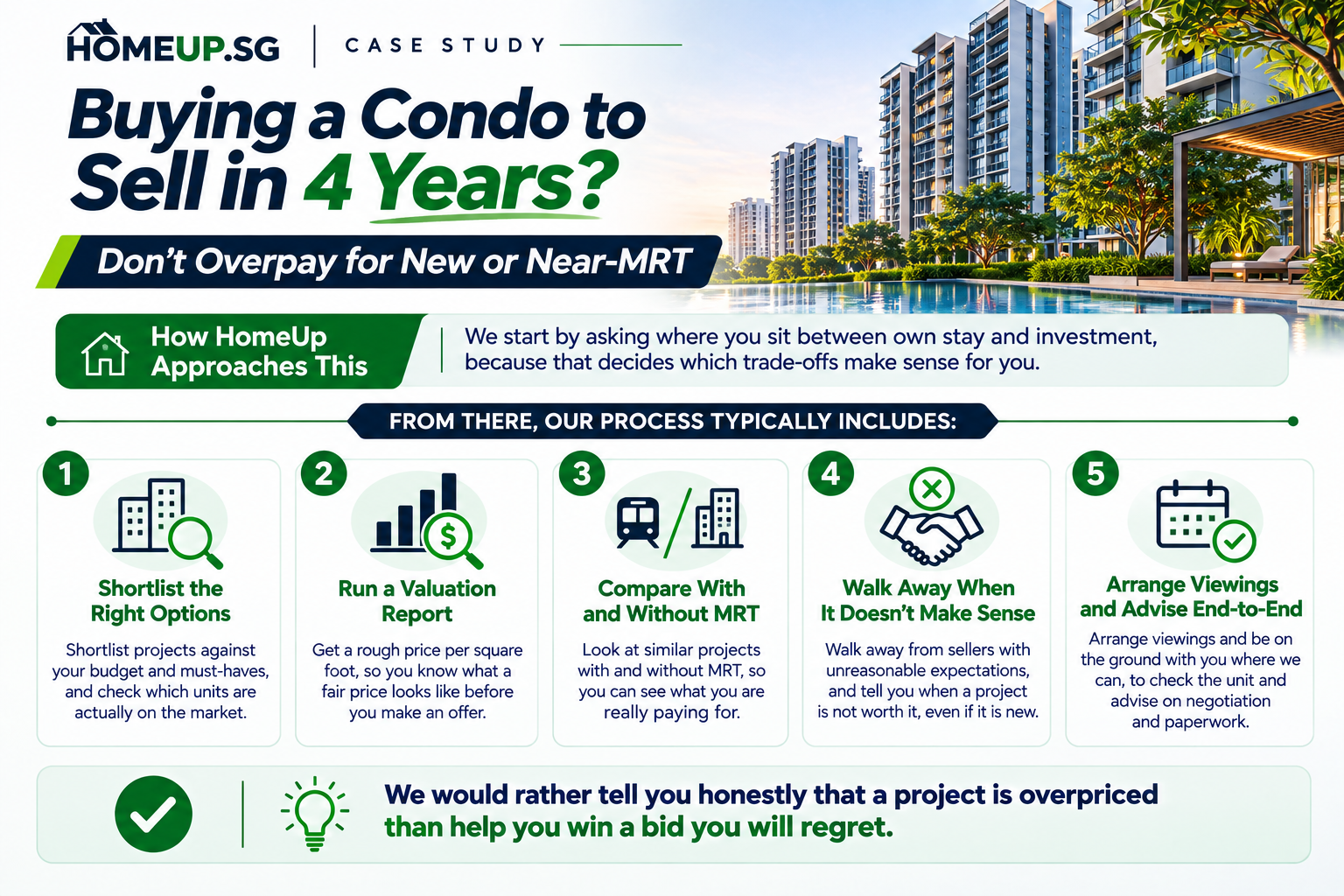
We start by asking where you sit between own stay and investment, because that decides which trade-offs make sense for you.
From there, our process typically includes:
Shortlisting projects against your budget and your must-haves, and checking which units are actually on the market.
Running a valuation report with rough price per square foot, so you know what a fair price looks like before you make an offer.
Comparing similar projects with and without MRT, so you can see what you are really paying for.
Walking away from sellers with unreasonable expectations, and telling you when a project is not worth it, even if it is new.
Arranging viewings and being on the ground with you where we can, to check the unit and advise on negotiation and paperwork.
We would rather tell you honestly that a project is overpriced than help you win a bid you will regret.
Conclusion
A short holding period does not mean you should chase the newest, closest-to-MRT project at any price. It means you should buy something the next buyer will want, at a price that leaves room to exit. New and near-MRT both help, but they are both already priced in, so the real work is finding where you are not paying twice for them.
Buyers who understand what they are paying for tend to negotiate better, walk away from bad deals more easily, and exit with fewer surprises.
Tong Boon is the Co-Founder of HomeUp #1 Transactor in Singapore | 2025 (Private Resale, Buyer Represented), a flat-fee real estate advisory in Singapore. He was featured as an independent property expert on CNA's Open House for his views on the Private Residential Market. He also heads the award-winning Champion Private Buying Division in his Agency.
This article reflects his independent views and is not affiliated with any developer or sales team. Client names have been changed to protect their privacy.