
Quick Answer
There's no universal "better" between HDB and condo. It depends on four things:
Your final property goal: where you want to end up in 15-20 years, and whether this purchase moves you toward it.
Holding period: condos in their first 1-10 years typically appreciate fastest; buyer interest softens once a project passes the 20-year mark.
The space-lease-location trade-off: two out of three at your budget, rarely all three.
New launch vs resale fit: new launch suits buyers with somewhere to stay during construction and a higher risk appetite. Resale suits buyers who need to move in now.
One rule of thumb: if you're not tied to a location for family reasons and you're buying condo, younger leasehold under 10 years old is the safer long-term bet over older or freehold, unless you're genuinely committed to a 20-year hold.
Introduction

"Can we afford a condo?" sounds like the right opening question. It isn't.
I've helped many HDB upgraders move into private property, and affordability is rarely the real blocker. The real blocker is that most families haven't decided what their property journey actually looks like. Without that, no loan calculation gives you a clear answer.
I recently sat down with a couple, late 30s, two young kids, a helper at home, currently in a 3-room flat. They needed at least a 3-bedroom-plus-study. Beyond that (condo, resale HDB, new launch), everything was still on the table. I'll use their case (details changed) because it's the exact conversation I have on repeat.
Why does affordability come second, not first?
Because affordability without direction just produces a number, not a decision.
Any couple I sit down with can get a rough loan quantum in the first ten minutes. That part is mechanical. Age, income, bonus structure, existing debt. Once there's an in-principle approval (IPA), the number gets very accurate.
But knowing you can borrow $2.6 million tells you nothing about whether you should. Or whether a $2.4 million unit with slightly less lease or a lower floor actually serves you better.
So before any of that, I ask: what's your final property goal?
Tell me you want to end up landed by 50, and I know you need to be aggressive: capital appreciation has to compound hard from here, because landed doesn't fall into your lap by accident. Tell me you want to cash out to a smaller HDB eventually and travel, and that's a completely different, equally valid plan.
Once I know the destination, I can tell you whether today's purchase is a stepping stone or a final home. That single answer changes how much risk actually makes sense.
New launch or resale: which actually fits most upgraders?
Here's where I part ways with a lot of standard agent advice.
A lot of agents default to "buy new launch, buy new launch." From what I've actually transacted, roughly 80% of upgraders are better suited to resale.
New launch has real upside: progressive payment means you're not paying the full loan from day one, and everything's new, so you skip the renovation cost resale buyers have to budget for. But it also comes with a 2-3 year build. No place to stay in the interim, and rental becomes a sunk cost eating into the "expected returns" agents love putting on a slide.
The split, plainly:
New launch fits you if: you have somewhere to stay during construction, you're fine with a longer runway to move-in, and your risk appetite leans aggressive.
Resale fits you if: you need to move relatively soon, you want to see exactly what you're buying, and you'd rather not carry rental on top of a mortgage.
New launch isn't wrong. It's a strategy for a specific buyer, and most upgraders I meet aren't that buyer by default. They just haven't been told there's a choice.
Why does lease age matter this much?
Because it directly affects how easily you exit later, and every buyer eventually has to think about exit, even if it's not top of mind on day one.
From transaction data and from watching deals happen firsthand: condos in their first 1-10 years typically show the strongest appreciation. 10-20 years, performance is still reasonable, call it a maturing phase. Past 20 years, momentum usually slows.
I see this on the buyer side too. Once a project crosses roughly the 20-year mark from its lease start date, enquiries about remaining lease spike noticeably. The logic is simple: buy a 20-year-old condo, hold another 5-10 years, and you're now selling a shorter-runway property into a shrinking pool of interested buyers.
This is why I steer upgraders away from freehold unless they're genuinely committed to a 20-year hold. Freehold carries a premium: usually a smaller unit or a more awkward location for the same budget. Young leasehold tends to outperform freehold early on; freehold only starts to shine at 20 years and beyond.
What's the trade-off most buyers don't see coming?
Space, lease, location. You get two. Rarely all three, at any given budget.
This, not affordability, is the biggest problem I'm actually solving for most buyers. Want all three? Your mortgage stretches. Want to protect your mortgage comfort? Something else gives.
I frame it as prioritisation, not compromise. Half of what happens on a viewing isn't inspecting the unit. It's watching a family discover, in person, which of the three actually matters most to them. A layout that reads perfectly on paper can fall flat once you're standing in it. And a project that looked "just okay" on listings sometimes wins because it's genuinely walkable to the kid's school.
Practical Framework
Work through these, in this order, before touching a single listing:
Final property goal: where in 15-20 years? Landed, staying condo, or eventually downsizing?
Holding period: 5-6 years to refresh the lease, or long-term?
Financing comfort: not your maximum loan. The monthly instalment you're actually comfortable carrying.
Space-lease-location priority: rank the three. One gives.
New launch readiness: somewhere to stay for 2-3 years if it's required?
Family constraints: school proximity, parents nearby, helper accommodation.
Exit expectations: funding the next move, or long-term hold?
Answer these honestly and the HDB-vs-condo call is usually obvious before you've viewed anything.
How HomeUp Approaches This
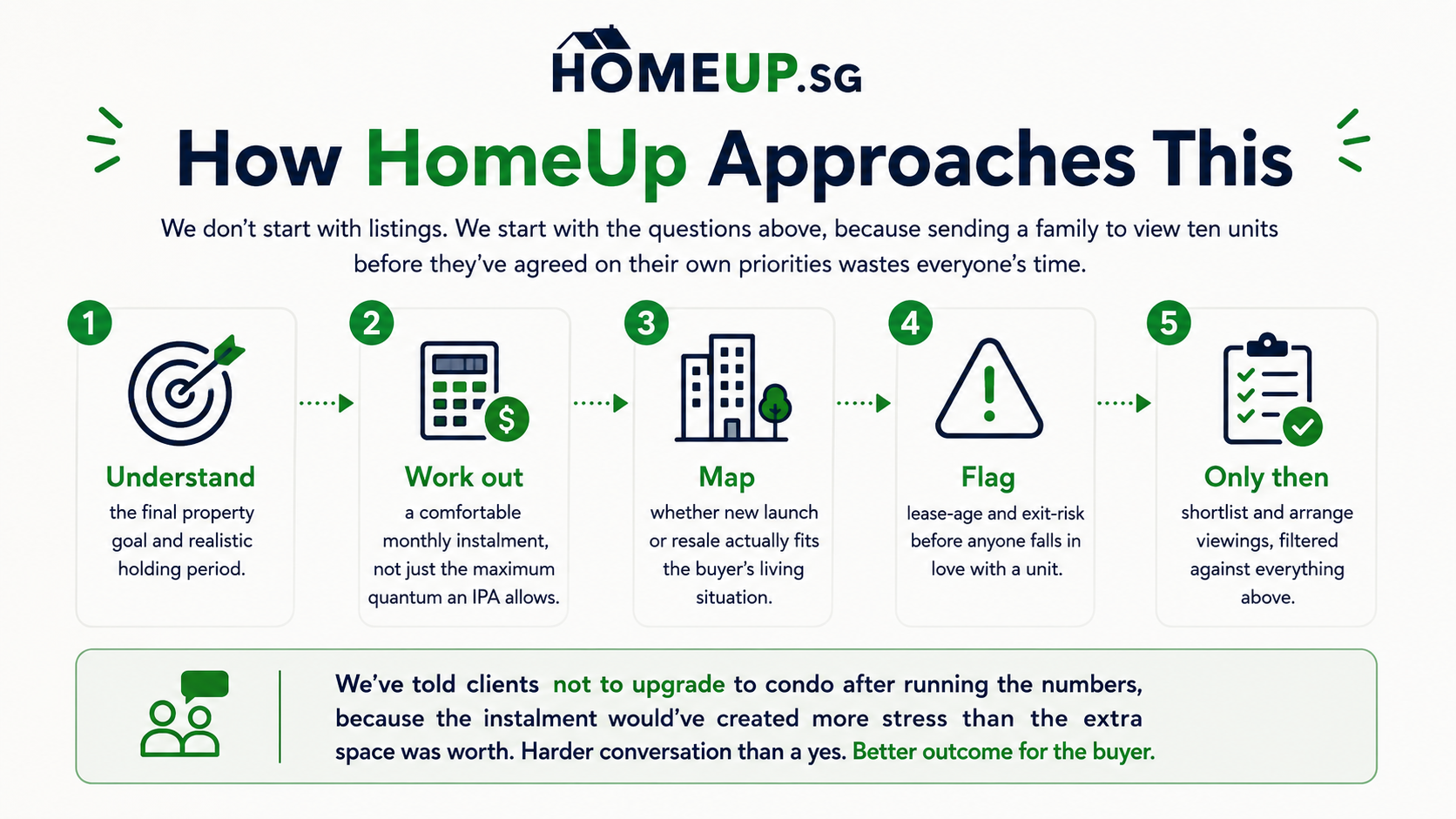
We don't start with listings. We start with the questions above, because sending a family to view ten units before they've agreed on their own priorities wastes everyone's time.
Understand the final property goal and realistic holding period.
Work out a comfortable monthly instalment, not just the maximum quantum an IPA allows.
Map whether new launch or resale actually fits the buyer's living situation.
Flag lease-age and exit-risk before anyone falls in love with a unit.
Only then shortlist and arrange viewings, filtered against everything above.
We've told clients not to upgrade to condo after running the numbers, because the instalment would've created more stress than the extra space was worth. Harder conversation than a yes. Better outcome for the buyer.
Conclusion
There's no single "best" between HDB and condo, or new launch and resale: it genuinely depends on your final goal, your holding period, your instalment comfort, and how you rank space against lease against location.
But the families who end up happiest aren't the ones who chased the biggest loan they qualified for. They're the ones who answered the final-goal question before they answered the affordability one.
Get that order right, and the rest is arithmetic.
Tong Boon is the Co-Founder of HomeUp, a flat-fee real estate advisory in Singapore. He was featured as an independent property expert on CNA's Open House for his views on the Private Residential Market. He also heads the award-winning Champion Private Buying Division in his Agency.
This article reflects his independent views and is not affiliated with any developer or sales team. Client names have been changed to protect their privacy.