

Quick Answer
If you plan to hold your first condo for ten years or more, run these three tests before you buy:
The resilience test. Could you still carry the mortgage if your income took a hit? Be confident in your job for the next four to five years, and keep enough cash to cover the instalments if one income stops. If you would be stretched thin, staying in your HDB can be the right call.
The exit test. Work out how old the condo will be when you sell. Buyers tend to grow cautious once a condo passes roughly 20 years, so if freehold is not available in your area, choose the newest project you can afford.
The waiting test. Holding out for the perfect option, such as an EC ballot, has a cost. HDB to condo is a more expensive asset class, and the gap can widen the longer you wait.
Underneath all three sits one question: where does this condo fit in your life plan?
Introduction
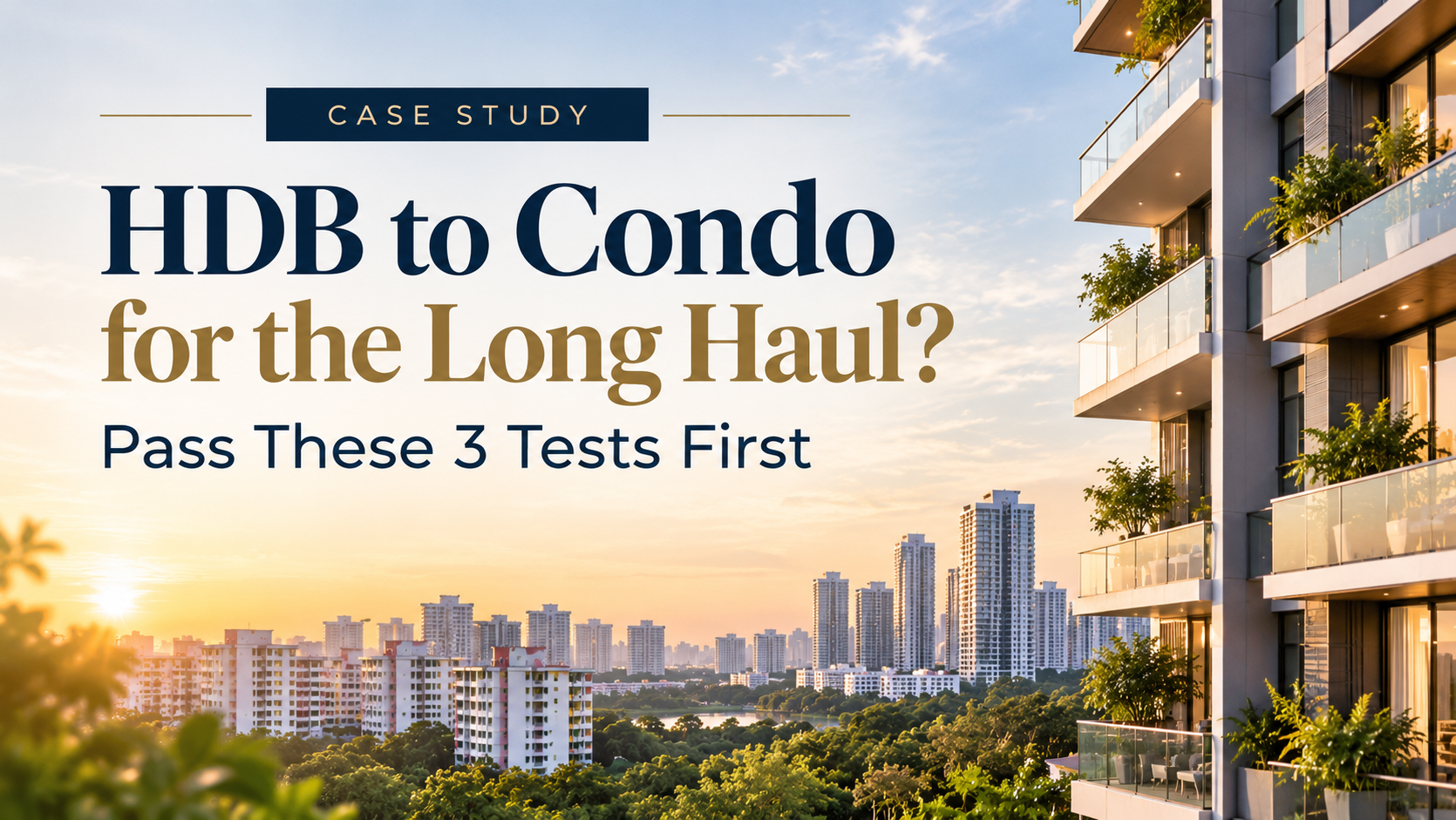
For the longest time, the couple I spoke with assumed their HDB would be their forever home. That is how their parents did it: pay it off, stay put, and enjoy the spare cash. Then their MOP got closer, agents started knocking, and they began to wonder whether staying meant leaving growth on the table.
They have two young boys, they want to stay on the east side near schools they hope to get into, and they already had two newer condos in their own estate on their radar. What they really wanted to know was what a long stay in a condo would look like.
I do not think either mindset is wrong. In our parents' time, one house that you pay off and enjoy was a perfectly sensible plan. Circumstances have changed since then, and for many families it is now a trade-off between lifestyle and investment. But if you decide to upgrade, I want you to do it with your eyes open. For a long hold, that means passing three tests.
Is upgrading really better than staying in your HDB?
Not always, and I say that to every upgrader I meet.
Staying put is a legitimate plan. If you pay off the flat and keep your spare cash for travel or retirement, life stays simple. The trade-off is that you may leave potential growth on the table, and you will likely have less to pass on.
On the other side, a condo mortgage is real. A lot of agents will not say this, but I will: you have to be confident that you can carry it. That brings us to the first test.
Test 1: Could you still carry the mortgage if something goes wrong?
Before we talk about any project, I ask two things. How confident are you in your job over the next four to five years, and are both of you working? And do you have enough cash reserve to cover the instalments even if one of you is out of work for a while?
If the answer to both is yes, a condo mortgage is manageable. If you are playing it very thin and you are scared of losing your job, I would honestly say to consider staying in your HDB. I will still help if you want to go ahead, but I would rather you hear the risk from me now than feel it later.
This is also why I link every upgrader to a mortgage broker early. They can run a full financial report and show you what the instalments look like at different price levels, using the banks' real assessments instead of a rough estimate. I am not a financial advisor, and your insurance and investment planning belong with whoever handles that for you. My job is the property side.
Test 2: Who will buy it from you in 12 years?
If you plan to stay for around 12 years, you are not just buying a condo. You are buying a condo that will be 12 years older when you sell it.
Do the age math first. Say you buy a project that completed five years ago. Twelve years later, it is 17 years old. In my experience, that is still sellable. Once a project crosses the 20 to 22 year mark, buyers become more cautious. I like to use a human life cycle to explain it. A project of one to five years is a baby, five to ten is a teenager, ten to twenty is an adult, and past 20 it is middle-aged.
Why does that matter? Buyers who consider a condo that is already 20 years old worry about trying to sell it at an even older age. So the pool narrows to people who are near the end of their property journey, which is small, because most upgraders want something newer. There are exceptions. I once sold a condo in a district with very thin supply that was already in its 20s, and demand surprised me because the layout and facing were good and there were few alternatives. But I would not plan around being the exception.
Freehold is the other lever. If you hold for ten years or more, freehold tends to pull ahead of leasehold after roughly the ten-year mark. The catch is that some towns have very few freehold condos. If you have none to choose from and you are staying long, buy as new as you can.
Then think about your future buyer. In 12 years, the people buying from you will often be those who cannot afford the newest launches and ECs, but do not want an old condo. A relatively young, reasonably priced resale sits right in that sweet spot. New launches and ECs nearby will compete with you, but they will be priced higher, and in my experience they tend to lift pricing in the area, which can make your unit look more affordable beside them.
No one can promise how any project will perform. What you can do is lower the risk of being unable to exit.
Test 3: What is waiting costing you?
Many upgraders I meet are waiting for something: an EC ballot, a better time, a lower price. I understand why. ECs are popular, and in my experience the good ones are heavily oversubscribed. If you keep balloting, you keep delaying your plans, and in a given year there may only be one or two ECs launching near where you want to live. ECs also have their own eligibility rules, so check the current criteria with HDB.
The silent cost of waiting is that HDB to condo is a more expensive asset class. If condo prices keep rising and your HDB proceeds do not keep pace, the gap widens, and you can get priced out. That is what I have observed on the ground. It is not a forecast, and it depends on the market. But it is why I would often rather see a buyer take a good resale, with a good facing and a good layout, than wait on hope. If you are genuinely happy staying in your HDB forever, waiting costs you nothing, and that is fine too.
The same logic applies when you sell. Record prices are fleeting. If you wait a year for a higher price, you pay for it in time. In a market with plenty of HDB supply, viewers decide the demand, and multiple offers are what push a price up. I would rather list at an attractive price, get as many viewings as possible, and let competing offers do the work.
Where does this condo fit in your life plan?
Here is the path I see most often for families like this. Stay in the first condo for about 12 years while the kids grow up. Perhaps move once more if the opportunity is there. Then, at the end, many families buy a smaller place, often a two-bedroom in a smaller freehold project, to unlock cash.
Not everyone goes back to an HDB. In my experience, roughly half of those who plan to return to an HDB end up staying in a condo, because they realise they can afford a smaller condo and still have enough cash for retirement. Plans also change. A child may want to study near a university, or an income may jump, and the whole plan shifts.
That is why I ask every client: what is your final dream home? You do not need to answer straight away, but it decides the route. This couple ruled out landed because they worried about the ongoing costs if their income did not grow, and I think that is a reasonable position.
Practical Framework
Before you commit to a long hold, work through this:
Define your final dream home. Landed, a smaller condo, or back to an HDB? You do not have to be sure, but you should have a direction.
Run the resilience test. Job confidence for the next four to five years, both incomes, and a cash reserve. Get a broker's report on instalments at different price levels.
Do the age math. Add your holding period to the project's current age. Compare the result with the 20-year mark.
Check freehold availability. If your preferred area has none, go for the newest project you can afford.
Know your future buyer. Aim to sit between the newest launches and the old stock.
Price the cost of waiting. ECs, ballots and widening gaps all have a cost, unless you plan to stay in your HDB for good.
Shortlist projects before units. You cannot buy before your HDB sale is moving, so study the projects first and view units once your listing is live.
Plan the sale to attract offers. List at an attractive price and aim for multiple viewings.
How HomeUp Approaches This
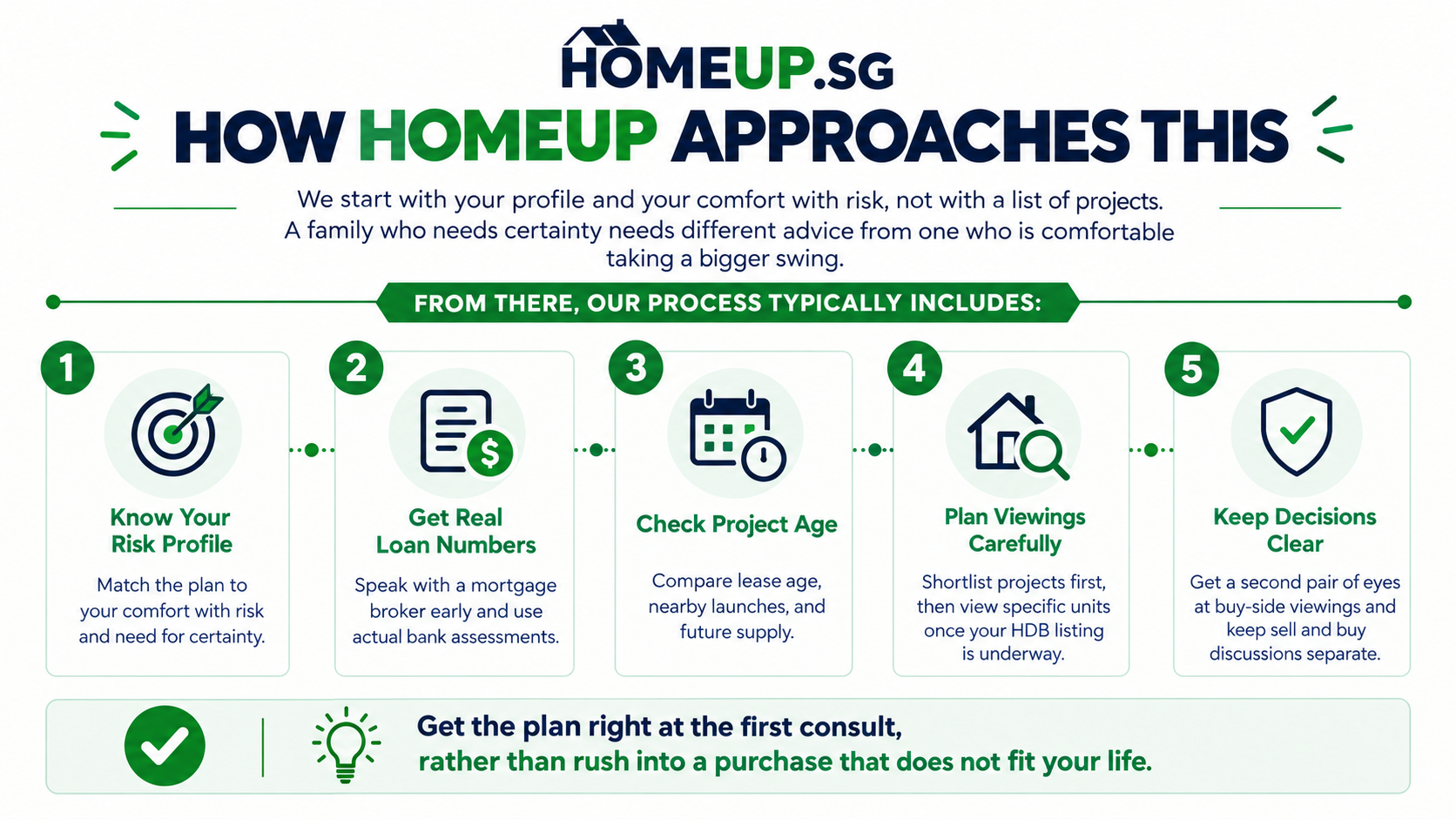
We start with your profile and your comfort with risk, not with a list of projects. A family who needs certainty needs different advice from one who is comfortable taking a bigger swing.
From there, our process typically includes:
Connecting you with a mortgage broker early, so the budget rests on real bank assessments.
Running the age math on every shortlisted project, and comparing it with nearby launches and future supply.
Shortlisting projects first, then arranging viewings for specific units once your HDB listing is underway.
Accompanying you on the buy-side viewings, so you have a second pair of eyes on the unit.
Keeping sell and buy conversations in separate chats, so decisions do not get mixed up.
We would rather spend time on the first consult getting the plan right than rush you into a purchase that does not fit your life.
Conclusion
There is no single right answer for every HDB upgrader. Some families are happiest staying put, and others gain from upgrading. What matters is whether you can carry the mortgage when life gets uncomfortable, whether a future buyer will still want your condo when you sell, and whether waiting is quietly costing you more than acting.
Families who pass all three tests tend to make calmer decisions, and they are more likely to be happy with them years later.
Tong Boon is the Co-Founder of HomeUp #1 Transactor in Singapore | 2025 (Private Resale, Buyer Represented), a flat-fee real estate advisory in Singapore. He was featured as an independent property expert on CNA's Open House for his views on the Private Residential Market. He also heads the award-winning Champion Private Buying Division in his Agency.
This article reflects his independent views and is not affiliated with any developer or sales team. Client names have been changed to protect their privacy.