
Quick Answer
Upgrading from an HDB to a condo isn't simply about finding a property you can afford.
It's two transactions happening at the same time, selling your HDB and buying your private property. Your CPF, cash, loan, and timeline all have to line up.
The safest approach is to:
Check your HDB MOP date.
Calculate your actual HDB sale proceeds.
Check your loan ceiling and financing.
Work out your down payment and taxes.
Decide whether to sell first or buy first.
Sell your HDB.
Search for the right condo.
Coordinate both timelines.
Complete the purchase and plan your new financial position.
The key isn't just which condo you buy. It's how you sequence the entire upgrade.
Introduction
Most HDB upgraders start by browsing condos.
According to HomeUp's approach, that's the wrong place to start.
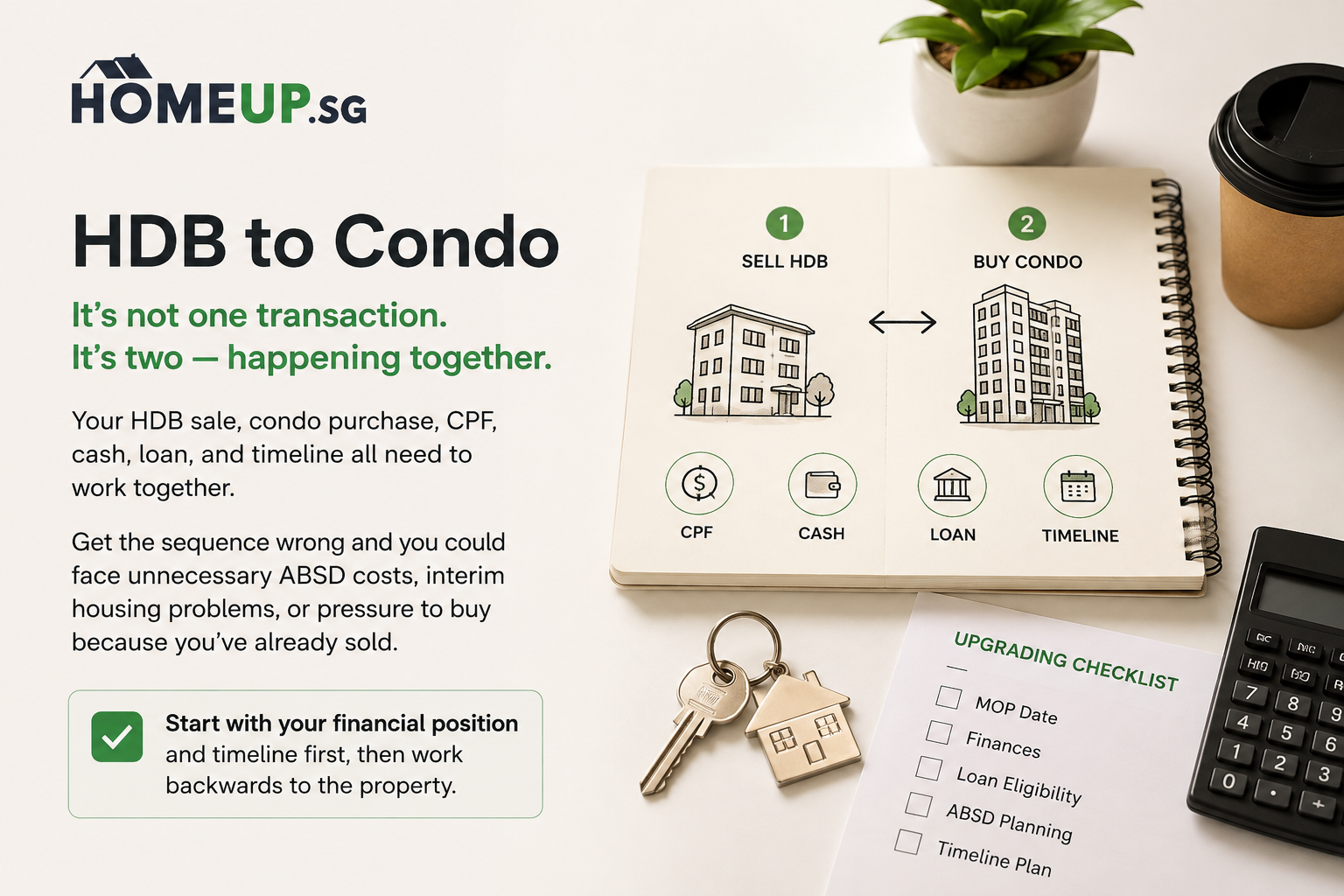
An HDB-to-condo upgrade involves two major transactions happening together. Your HDB sale, condo purchase, CPF funds, cash requirements, loan eligibility, and moving timeline all need to work together.
Get the sequence wrong and you could face unnecessary ABSD costs, an interim housing problem, or pressure to buy because you've already sold your HDB.
The better approach is to start with your financial position and timeline first, then work backwards to the property.
When can I sell my HDB?
Your Minimum Occupation Period (MOP) is generally 5 years from key collection, not from the date you signed your Sale & Purchase Agreement.
For BTO owners, the actual timeline can therefore be longer than expected.
Before planning your upgrade, check your exact MOP date and work backwards from there. If you received CPF Housing Grants, you should also check whether there are any applicable conditions or clawback provisions.
How much money will I actually have after selling my HDB?
Don't simply look at your estimated selling price.
You need to deduct:
Outstanding HDB loan
CPF principal used plus accrued interest
Legal fees
Agent costs
What's left is your actual cash position, while the CPF refund goes back into your CPF OA for your next purchase.
This is why your paper profit isn't necessarily the same as cash in hand.
How much condo can I afford?
Your affordability should be based on more than your desired monthly mortgage.
You need to consider:
TDSR
Existing loans
CPF OA balance
Cash savings
HDB sale proceeds
Downpayment
BSD
Renovation
Maintenance fees
Property tax
The guide highlights that under TDSR, total monthly debt obligations, including your mortgage, cannot exceed 55% of gross monthly income. Getting an In-Principle Approval from a bank before seriously viewing properties can help establish your actual borrowing capacity.
Should I sell my HDB before buying a condo?
There is no universal answer.
Sell HDB first
Pros:
Avoid paying ABSD on the second property.
Know your exact sale proceeds.
Lower financial risk.
Potential downside:
You may need temporary housing if the timelines don't match.
Buy condo first
Pros:
You can move directly from your HDB into the condo.
Less risk of being temporarily without a home.
Potential downside:
You may need to pay ABSD upfront, with remission potentially available if the HDB is sold within the applicable timeframe.
The right sequence depends on your cash position, risk tolerance, and target property.
How should I price my HDB for sale?
Don't base your asking price purely on portal estimates.
Look at recent transacted prices in your block and nearby blocks, particularly transactions from the previous 3-6 months.
You can also negotiate more than just price. Completion dates, extensions, furniture, and fittings can all affect how smoothly your HDB sale connects with your condo purchase.
What should I look for when choosing a condo?
Don't let showflat emotions determine the purchase.
Consider:
Price psf compared with recent transactions
Rental demand
Exit liquidity
School catchment
Tenure
New launch versus resale
Your intended holding period
The question isn't only "Do I like this condo?"
It's also:
"Who will buy this condo from me when I'm ready to sell?"
What happens after I find a condo?
For a private property purchase, you'll negotiate the price and receive an Option to Purchase (OTP).
The guide outlines the typical process as:
Pay a 1% option fee.
Receive the OTP.
Exercise the OTP within 14 calendar days by paying the additional 4%.
Engage your property lawyer before exercising.
Pay BSD within the required timeframe.
Your IPA and lawyer should be in place before you start seriously viewing properties.
How HomeUp Approaches This
HomeUp doesn't start the upgrading process by showing you condos.
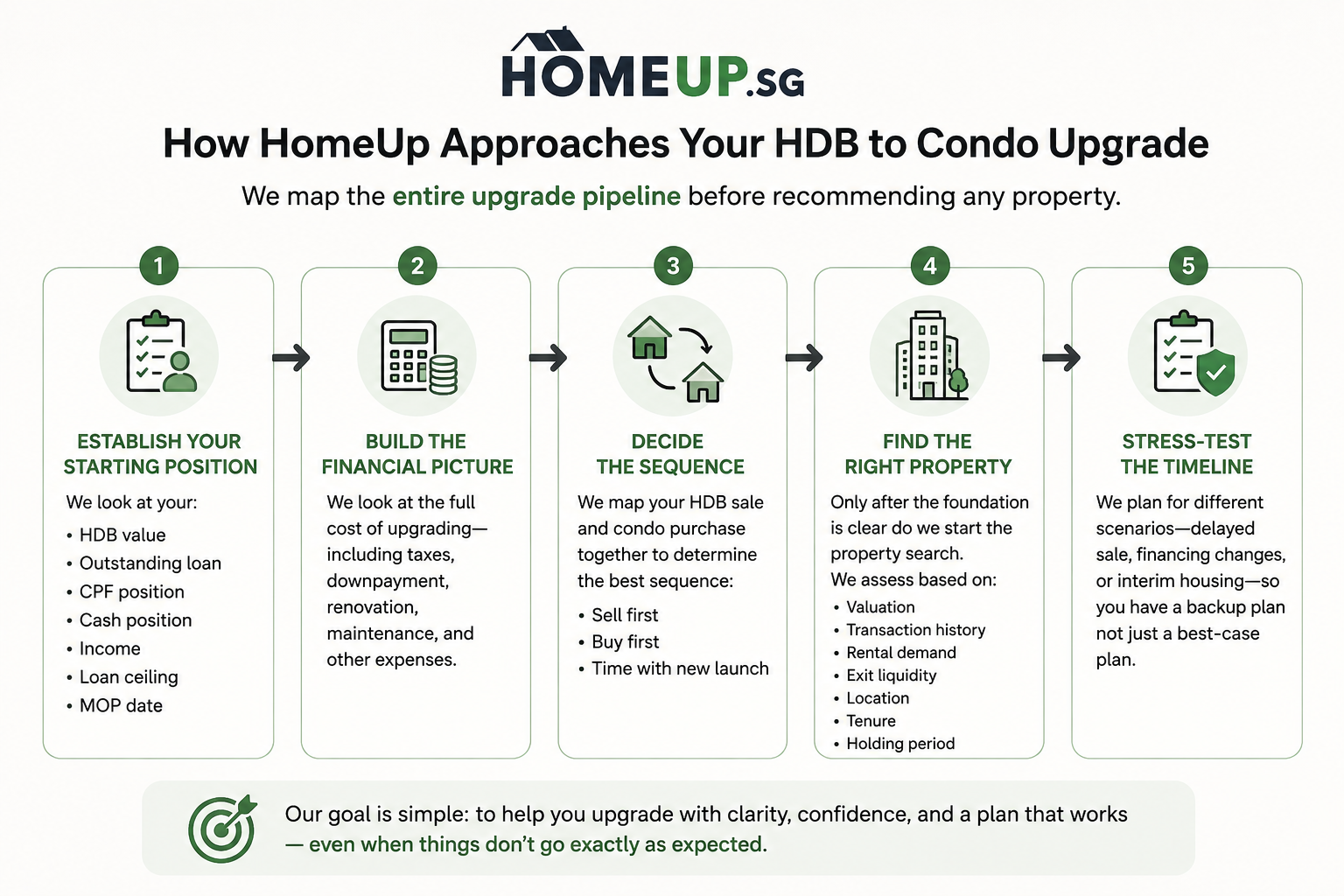
It starts by mapping out the entire upgrade pipeline.
Step 1: Establish your starting position
The team looks at your:
HDB value
Outstanding loan
CPF position
Cash position
Income
Loan ceiling
MOP date
Step 2: Build the financial picture
Instead of asking only, "What condo can I afford?", HomeUp looks at the full cost of upgrading, including taxes, down payment, renovation, maintenance, and other expenses.
Step 3: Decide the sequence
The HDB sale and condo purchase are mapped together so you know whether selling first, buying first, or timing around a new launch makes the most sense.
Step 4: Find the right property
Only after the financial and timeline foundation is clear does the property search begin.
Properties are assessed based on valuation, transaction history, rental demand, exit liquidity, location, tenure, and the buyer's intended holding period.
Step 5: Stress-test the timeline
HomeUp also considers what happens if the HDB takes longer to sell, financing changes, or temporary housing becomes necessary.
The goal is not simply to make the upgrade work under perfect conditions, but to make sure there's a plan when things don't go exactly as expected.
Conclusion
An HDB-to-condo upgrade is manageable, but it rewards preparation.
The biggest mistake is thinking that the process starts with choosing a condo.
It actually starts with understanding your MOP, finances, CPF, loan capacity, sale proceeds, taxes, and timeline.
Once those pieces are clear, you can determine which property makes sense and how to coordinate the sale and purchase without unnecessary financial pressure.
The sequence matters as much as the property.
Plan the numbers first. Plan the timeline next. Then choose the condo.
Tong Boon is the Co-Founder of HomeUp, a flat-fee real estate advisory in Singapore. He was featured as an independent property expert on CNA's Open House for his views on the Private Residential Market. He also heads the award-winning Champion Private Buying Division in his Agency.
This article reflects his independent views and is not affiliated with any developer or sales team. Client names have been changed to protect their privacy.