

Quick Answer
A condo is easy to sell when buyers have a clear reason to choose it over the neighbours. Freehold, a young lease or a big size can help, but none of them is enough on its own.
Look for a catch point. The project should be the cheapest, the most convenient, the newest or the biggest in its stretch, or have some other clear advantage.
Avoid the death zone. This is my name for a middle-aged project that is not the cheapest, not the newest and not especially convenient, sitting next to similar projects chasing the same buyers.
Livability beats the label. A "forever home" that is awkward to live in often ends up being sold, usually in a project that is hard to sell.
Decide your final property goal first. Some buyers put everything into a freehold to hold for the family. Others buy a cheaper, older, convenient condo and keep cash aside.
Plan for an honest exit. Older condos tend to sell slower and feel a slow market first, so build in holding power.
Introduction
Most buyers I meet have already fallen for a label before they have asked the exit question. "It's freehold." "It's brand new." "It's big." All fair points, but a label is not a plan.
I recently spoke with a father in his 40s who wanted to upgrade within the same part of the west. His children were in school nearby, and his parents lived close. He had a firm budget with a bit of stretch, and he was willing to pay more for a large freehold-type unit, but not for a 99-year project at the same price.
His real worry was very clear: if he bought in now, could he exit in five to ten years at a similar price, so he would not be priced out of his next move? He had also noticed a lot of units from first owners sitting on the market in the project he liked, and he wondered whether early buyers were trying to offload.
That is exactly the right instinct. I told him honestly that I would not personally buy into that project, because it carried more exit risk than the alternatives. Then I walked him through the questions I use to judge any condo, and that is what this article is about.
Does freehold make a condo easy to sell later?
Not by itself. Freehold is one aspect, and it is rarely the deciding one.
What matters more is whether you can actually live in the project for a long time. I have helped many owners sell condos they once believed were their forever homes. They did not leave because of the tenure. They left because the kids were tired of the journey to school, or the location was inconvenient, or the family's needs changed. When that happens in a boutique project that is hard to sell in general, the owner ends up waiting a long time.
Freehold also tends to carry a premium. That usually means a smaller unit or a more awkward location for the same budget. If you are not planning to hold for a very long stretch, you are paying for something you may not use.
What exactly is a catch point?
It is the reason a buyer chooses your project over the others around it.
From selling a lot of condos, I have noticed that projects tend to struggle when they have no catch point. A project that sits in the middle of nowhere, with nothing to offer, is the hardest to move. A catch point can be one of a few things. You can be the cheapest, so buyers who are watching their budget come to you. You can be the most convenient, for example right next to an MRT station. You can be the newest or the biggest. Or you can have something unusual that others do not.
Here is a real example of how this plays out. For this buyer, I suggested an older condo near an MRT station. It was built in the late 1990s and offered a very large unit for a price well below his stretch budget. It is old, and it will not sell as easily as a new development. But it has a clear catch point: it is extremely convenient. I was not worried about renting it out, and I felt its selling time would not be worse than the newer boutique project he had found.
What is the "death zone"?
It is where a project has no catch point and too much competition.
Picture a project that is about 20 years old by the time you want to sell. It is not the cheapest, it is not the newest, and it is not especially convenient. Next to it are two or three similar projects. That is the death zone. From a buyer's point of view, there are lots of equally good choices, so why would they pick yours?
I felt this was a bigger risk for a mid-aged project with a smaller unit than for the older, convenient condo. When someone spends more to upgrade to a condo, they usually want a bigger unit. If your unit is squeezy and your project is old by the time you sell, a buyer who can stretch will simply go for a newer, larger project nearby.
A useful check is to look at how many units are listed compared with how many are actually selling, and whether rental transactions are happening. In one project we looked at, there were no rental transactions for a couple of months. That is a warning sign for both selling and renting out.
What should I decide before I choose a project?
Your final property goal, because it changes which kind of project makes sense.
In my experience, buyers usually follow one of two schools of thought. The first is to put everything into a freehold and hold it all the way, with the family in mind. This is a wealth-preservation move, not a growth play, and the buyer should not expect a big gain in five to ten years. The second is to buy a much cheaper, older condo to stay in, and keep the difference aside for retirement or other investments. For example, if a freehold unit costs about $2 million and a comparable older leasehold unit costs about $1.2 million, the buyer keeps roughly $800,000 elsewhere.
Some buyers go the other way entirely and downsize. I have seen landed owners sell, buy an HDB flat near the MRT and unlock millions in cash, because their children had moved out and they no longer needed the space.
Your age matters too. It affects how long a loan you can take, so the holding period you plan needs to fit inside that runway. A mortgage broker can confirm your numbers.
What exit price should I assume?
An honest one, and not the best case.
For an older condo, I would assume a similar or lower price in ten years, and a longer time to sell, perhaps a year. In a slower market, older condos are usually the first to feel the squeeze. If you need to sell urgently, you will have to lower the price. If you have holding power, you can wait out the cycle.
That is why I keep returning to rentability. If you can rent the unit out comfortably, you are not forced to sell at a bad time. A convenient project gives you that fallback. A project in an awkward spot, with no recent rental transactions, may not.
None of this is a guarantee of how any project will perform. It is a way of asking harder questions before you commit, so you go in with your eyes open.
Practical Framework
Before you commit to a project, work through this:
Final property goal. Hold for the family, buy cheaper and keep cash aside, or plan to downsize later?
Holding period and loan runway. Make sure your plan fits within the loan tenure available at your age.
The catch point test. Write down in one sentence why a buyer would choose this project over the neighbours.
Count the neighbours. How many similar-age projects sit within the same stretch?
Liquidity signals. How many units are listed compared with how many are selling, and are rental transactions happening?
Livability. Will the commute work as your children change schools?
Exit stress test. Assume a lower price and a longer selling time. Can you still live with the outcome?
Offer discipline. Set your offer from the market numbers first, and only add a premium for what you personally value. If the seller wants far above that, be ready to walk away.
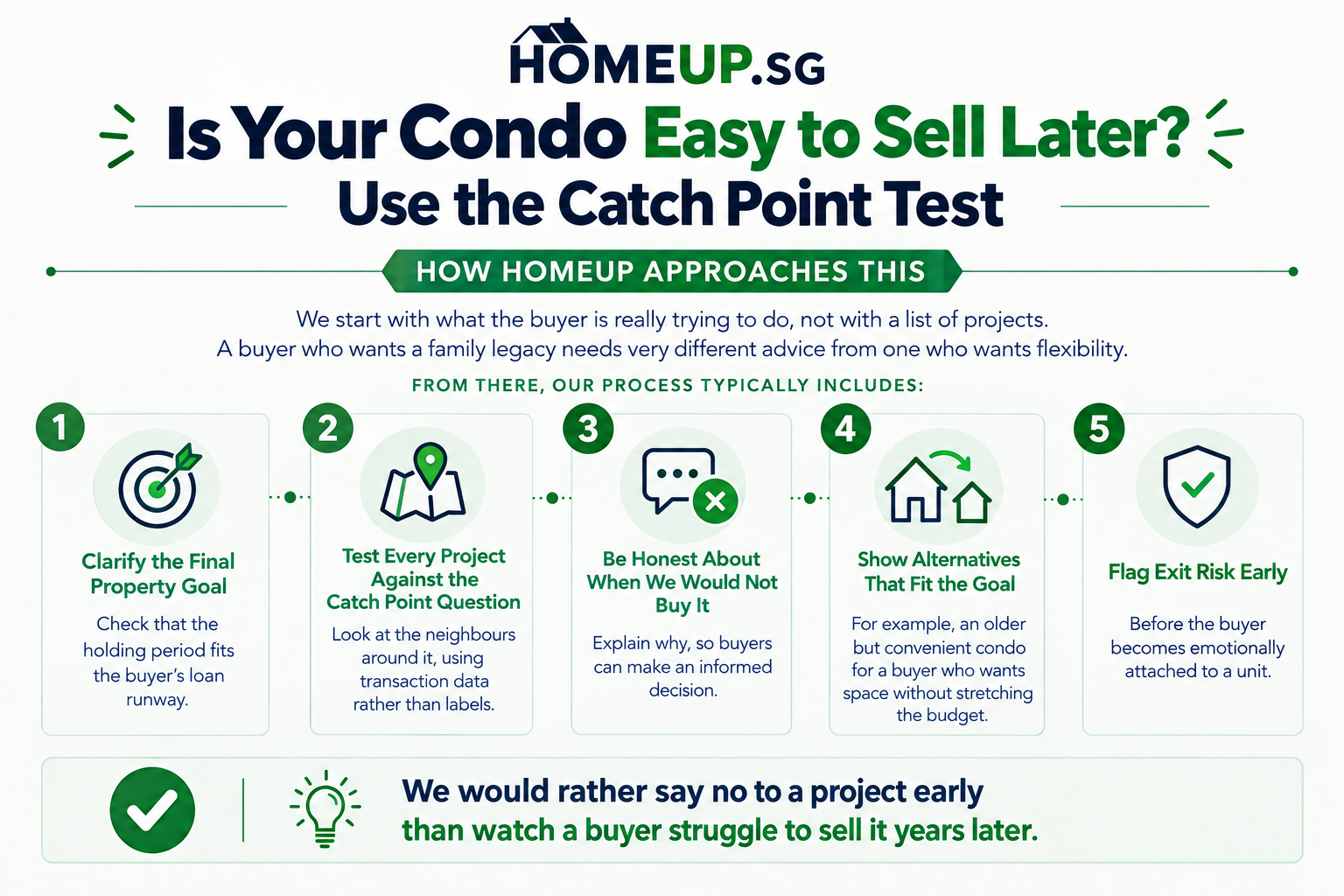
How HomeUp Approaches This
How HomeUp Approaches This
We start with what the buyer is really trying to do, not with a list of projects. A buyer who wants a family legacy needs very different advice from one who wants flexibility.
From there, our process typically includes:
Clarifying the final property goal and checking that the holding period fits the buyer's loan runway.
Testing every project against the catch point question and the neighbours around it, using transaction data rather than labels.
Being honest when we would not buy a project ourselves, and explaining why.
Showing alternatives that fit the goal, such as an older but convenient condo for a buyer who wants space without stretching the budget.
Flagging exit risk early, before the buyer becomes emotionally attached to a unit.
We would rather say no to a project early than watch a buyer struggle to sell it years later.
Conclusion
There is no single best type of condo. A freehold bought for the family, an older convenient unit that keeps your cash free, and a downsize to HDB can all be sensible, depending on your goal, your age and your tolerance for risk.
But before you commit to any of them, ask one question: if I had to sell in a slow market, why would a buyer choose this project over the one next door? If you cannot answer that clearly, the label is not enough.
Tong Boon is the Co-Founder of HomeUp #1 Transactor in Singapore | 2025 (Private Resale, Buyer Represented), a flat-fee real estate advisory in Singapore. He was featured as an independent property expert on CNA's Open House for his views on the Private Residential Market. He also heads the award-winning Champion Private Buying Division in his Agency.
This article reflects his independent views and is not affiliated with any developer or sales team. Client names have been changed to protect their privacy.