

Quick Answer
Landed listings near $4 million are rarely a trick, but they almost always involve a trade-off. Before you get excited:
Expect an entry-level home. At this budget, you will usually be looking at smaller land, a narrower house, or a home that is not in perfect condition.
Decide what you will give up. Near-MRT, freehold, size and condition rarely come together at this price. Rank them before you start viewing.
View a few to learn, not to buy. Seeing one to three landed homes teaches you which types you like, and some that look narrow from outside feel ample inside.
Landed supply is thin. A home that suits you may appear only once every couple of months, so the search can take half a year or more.
Age changes the maths. If you are close to 50, your loan runway shortens, so avoid putting everything into one bucket and keep a cash buffer for works.
Have a plan B. Know which area or requirement you can relax if the first choice does not appear in time.
Introduction

Most buyers do not go looking for landed. They stumble on it. That is exactly what happened to the couple I recently spoke with.
They were in their late 40s, and they had two properties to sell. While preparing to sell, they browsed a property portal and noticed that they might have enough budget to get into landed after all. The photos looked decent, the prices looked decent, and the locations looked decent. Their question to me was fair: is this a false direction, or is there really a bargain?
They also had a strong reason. They wanted freehold so they could leave something for their children, instead of a 99-year lease that decays. Their budget was around $4 million, and they did not want to throw everything into one property and then work another 15 years to pay for it.
My honest answer was: it is a real direction, but it is not a free lunch. Let me explain what I told them.
Are landed listings under $4 million a bargain or a trap?
They are usually neither. They are an honest trade-off that the photos do not show.
When a landed home looks cheap, ask what it is trading away. It may be the land size, which can be as small as 1,300 square feet when a typical terrace is closer to 1,600. It may be a very narrow frontage, or a layout so tight that you cannot park a car. Most landed buyers need a car, so parking is not a small detail. It may be the condition. Some homes are so run-down that architects buy them to rebuild and sell higher, and that is not what a couple who wants to move in with a light touch-up should be looking at.
I also tell buyers not to judge by the outside. Landed homes come in types. Some are wide and low with a front yard. Others are tall and narrow. A tall, narrow home may look unimpressive from the street, but once you step inside, a family of this size may find it ample, even with three or four storeys. You will not know until you walk in.
What will I probably have to give up?
One of the main criteria, most likely.
At around $4 million, you are choosing between near-MRT, freehold, size and condition, and you rarely get all four. This couple wanted freehold, a decent condition and a good size, and the wife also hoped for somewhere near an MRT. They were fine with a ten-minute walk, which helps.
But landed homes that are close to an MRT are rare and tend to be smaller. So the conversation becomes: how important is near-MRT compared with freehold? I often tell buyers that to get a better choice on one thing, you have to give up something on another.
If you want a decent home with a light touch-up, expect to spend a modest amount on renovation, perhaps a few tens of thousands. That is very different from a home that needs hundreds of thousands, or more, to become livable. Decide your ceiling before you view.
Why is landed so hard to find?
Because supply is thin and owners are patient.
A lot of freehold landed owners simply hold on and never sell. There can be an estate where nothing has been listed for ten years, and when one finally comes up, everyone rushes. That is why I say buying landed involves a bit of timing and fate.
Demand is also growing. In recent months, I have seen more landed buyers than condo buyers. As four and five-bedroom new launches reach four to five million dollars, many buyers look at landed instead. Around $4 million is a sweet spot for a lot of them, and many want freehold too, because they would rather not deal with lease decay.
So realistically, a home that suits your taste may come along only once every couple of months. The search often lasts around six months, and you should view diligently, week after week. The good news is that when you find the one, you will see light at the end of the tunnel.
Many buyers also see landed as a defensive asset, because only Singaporeans can buy it and supply is limited. That is a common view, but it is not a guarantee, and prices can plateau.
How does age change the plan?
It shortens your loan runway, so you need to be more careful.
If you are around 50, your mortgage runs towards age 65, so you may only have about 15 years. Banks look at your age when setting your loan tenure, so confirm the numbers with a mortgage broker. A mortgage is one stress, and working another 15 years to clear it is another.
That is why this couple wanted an entry-level landed home, and why I ask everyone the same question: what is your motivation? Is it a growing family, more space or legacy? Theirs was legacy, and that is a perfectly good reason. But it should be funded in a way that leaves you comfortable.
If I need to sell two properties first, how do I time the purchase?
With patience, and with a plan B.
Selling both properties may take six to nine months, and the buy is tied to it. Whatever supply is available at the time you sell becomes your list of options. You cannot rent for a year while you wait, so what you like today may be gone by then.
For now, I would not chase aggressively. Use this time to learn. View one, two or three homes so you can sort them into types and understand the pros and cons. Then, when your sale is close to firm, restart serious viewing.
Plan B matters. If you cannot find anything in your preferred area within budget, which areas could you widen to? For example, there may be cheaper freehold landed near a newer MRT station, though it may be further from where you live now. You could even make it a Sunday trip with the family and see how the area feels. And if your MRT requirement is too strict, you might need to relax it.
Practical Framework
Before you start viewing landed homes:
Name your motivation. More space, a bigger family, legacy or something else?
Set the budget with your loan runway in mind. Use a formal assessment, and keep a cash buffer for works.
Rank your criteria. Near-MRT, freehold, land size, condition and location. Decide which you will give up first.
Set a condition ceiling. How much touch-up can you accept, and what is too much?
Check the practical details. Frontage, parking, layout and how the interior actually feels.
View one to three homes to learn types. Do not rush to buy until your own sales are moving.
Plan for six to nine months. For selling both properties, and a search that may take months.
How HomeUp Approaches This
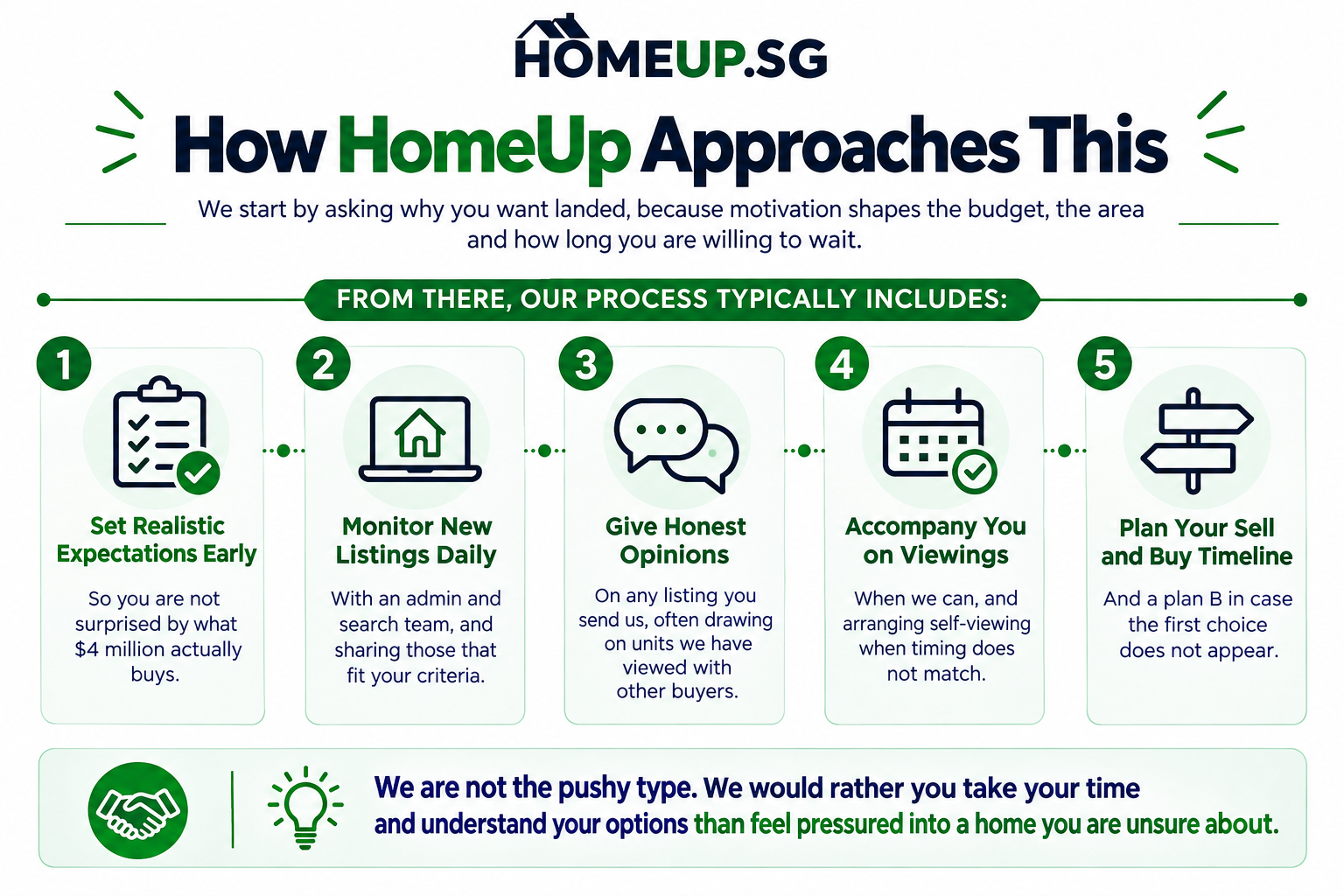
We start by asking why you want landed, because motivation shapes the budget, the area and how long you are willing to wait.
From there, our process typically includes:
Setting realistic expectations early, so you are not surprised by what $4 million actually buys.
Monitoring new listings daily with an admin and search team, and sharing those that fit your criteria.
Giving our honest opinion on any listing you send us, often drawing on units we have viewed with other buyers.
Accompanying you on viewings when we can, and arranging self-viewing when timing does not match.
Helping you plan the sell and buy timeline, and a plan B in case the first choice does not appear.
We are not the pushy type. We would rather you take your time and understand your options than feel pressured into a home you are unsure about.
Conclusion
Landed homes that look affordable are rarely a trick, but they are never free of trade-offs. The buyers who do best know why they want landed, decide what they will give up, and give the search the time it deserves.
Go in with realistic expectations, view a few to learn, protect your loan runway and keep a plan B. Then, when the right home appears, you will be ready to move.
Tong Boon is the Co-Founder of HomeUp, a flat-fee real estate advisory in Singapore. He was featured as an independent property expert on CNA's Open House for his views on the Private Residential Market. He also heads the award-winning Champion Private Buying Division in his Agency.
This article reflects his independent views and is not affiliated with any developer or sales team. Client names have been changed to protect their privacy.