
Quick Answer
If space is your top priority, keep these points in mind:
Expect a space trade-off. Newer condos are more compact. A unit of 1,400 to 1,500 square feet usually means an older project, unless your budget is very large.
Freehold suits a long hold. It tends to carry a premium of 5% to 10% or more over a 99-year lease, and there are fewer buyers when you sell. It makes sense if you plan to hold for ten years or more.
At around $4 million, compare with landed. Good landed homes are scarce and sell fast, and a run-down one can need around $1 million of works, so the real cost is higher than the asking price.
Hold more cash than you think. I tell buyers to keep roughly 10% of the purchase price in cash for option and exercise fees, stamp duty and other costs.
Know your end goal. If you want to end up in landed, sooner is usually better. If you do not, a condo can still get you to a comfortable exit.
Introduction
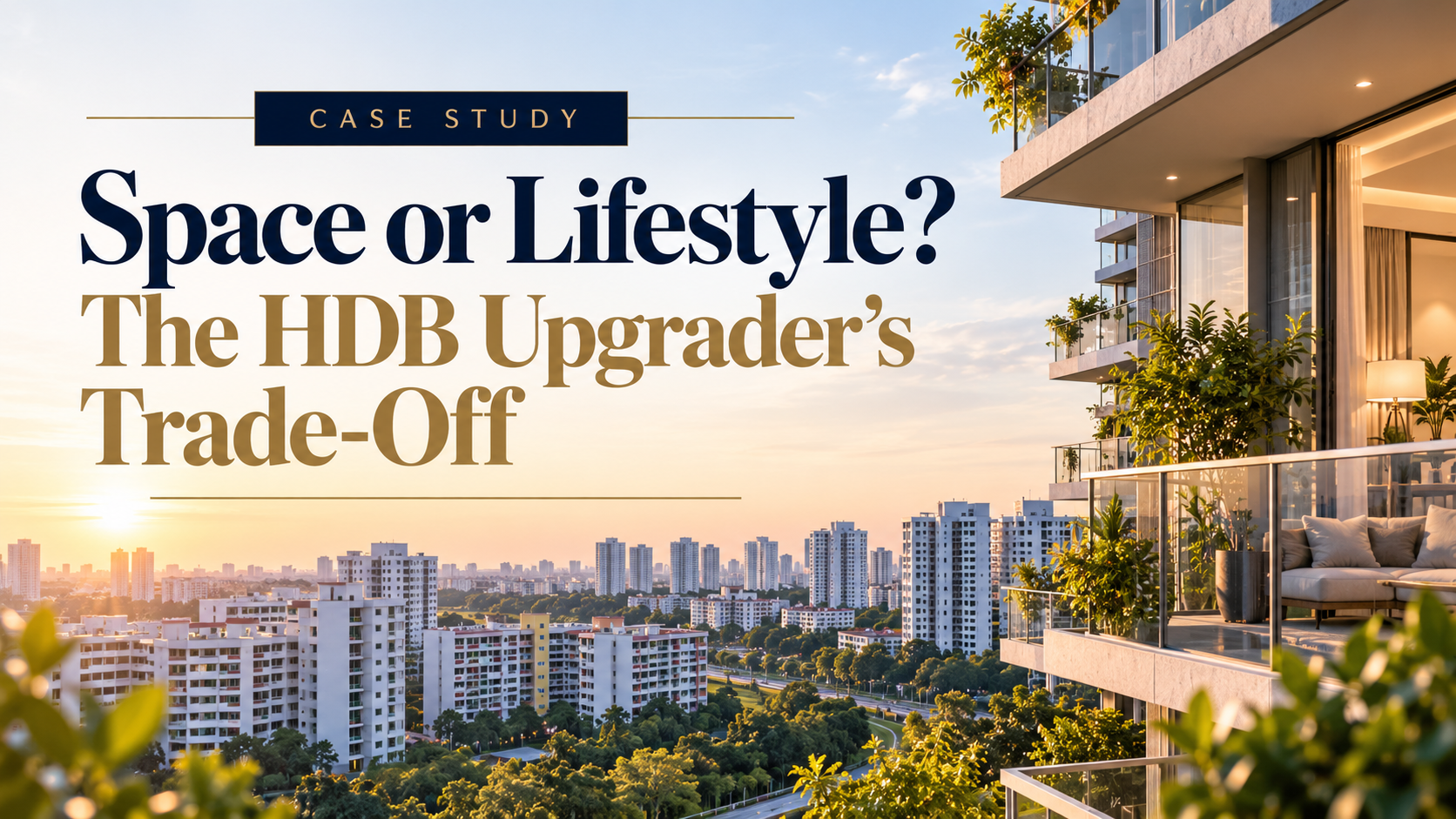
Most HDB upgraders are surprised by the one thing they did not expect to lose: space. An HDB flat is generous. A condo is more refined, with the facilities and the lifestyle, but for the same money you often get fewer square feet.
I recently spoke with a couple about to turn 40, living in a flat in the east and keen to stay in that part of Singapore. They told me straight away what they were not: they were not chasing quick returns. I have a name for buyers who are, the "raiders". They buy new launches, sell, buy again, and repeat every few years, often in locations picked for investment rather than for how they live. It can be very tiring for the family.
This couple wanted the opposite: comfort first, do not lose money, and treat any gain as a bonus. And what comfort meant to them was space. They wanted room for everyone to do their own thing, a workstation, a walk-in wardrobe and space for the kids to play. That sounds modest until you see what it costs.
Why does space become the hardest part of upgrading from HDB?
Because condos are priced per square foot, and the market has moved toward compact units.
A 1,400 to 1,500 square foot condo is much harder to find than most buyers expect. If you want that size, you will usually be looking at older developments, unless you have a lot of budget to spare. Newer launches simply do not offer it. I have been through a five-bedroom unit in a newer project at around 1,350 square feet. Once you put a bed in each room, you cannot do much else. That was not what this couple wanted.
So the first conversation is not about which project. It is about which trade-off you are willing to make: newer and smaller, or older and bigger.
If I choose a big older condo, should it be freehold?
If you plan to hold for a long time, it is worth serious thought. If not, it may not be worth the premium.
This couple did not want a 99-year lease on an older condo, because they had already experienced the lease ticking down on their HDB. They wanted to stay for at least ten years. For that holding period, freehold makes sense, because after about ten years it tends to shine more than a 99-year lease.
But I made sure they understood the catch. Freehold usually carries a premium of around 5% to 10% or more, and it can be harder to sell than a 99-year unit, because fewer buyers aim for freehold. You retain the value, but you may wait longer for the right buyer. Supply is also limited, and many freehold projects are small boutique ones. In my experience, a freehold project with more than 100 units is not too bad.
So the question is how picky you want to be. If you only have a few options, you have to be fine with that. A 99-year project opens up many more choices.
At around $4 million, should I look at landed instead?
You should at least compare, because the answer depends on what you want in the end.
This couple drew their own line: below $4 million, a condo, and above it, landed. I understand that. If a condo costs that much for a large unit, many buyers start to think they might as well buy landed.
But here is what I see on the ground. A year ago, you could find some freehold landed homes below $4 million. Now the market has moved fast. The ones with decent land size sell the moment they appear. We have seen listings drawing bids above the asking price. And the ones you can get under budget tend to be run-down. If you need to do additions and alterations, a good portion of a million dollars can go into the works, and costs can balloon quickly if you rebuild. So the asking price is not the real price. You need a proper buffer, and if your buffer is thin, going up to around $5 million is a risky stretch.
The couple also had a family landed property that might be sold, which could add to the budget. That is a strong option, but it depends on the family: whether the parents are comfortable moving, and how the proceeds are shared. I would treat that as a family discussion first, and a property plan second.
What is your end goal?
It decides the route, and you do not need to answer straight away.
I ask every client what their final home is. If your goal is to live in landed, the sooner you get there, the better, because supply is limited and many buyers are competing for it. A big part of that is that each person can only hold so many properties without heavy ABSD, so wealthy buyers increasingly buy bigger rather than more.
But not everyone wants landed at the end. I help many landed owners in their 60s sell, because the children have moved out and the house is too big to maintain. Some buy back an HDB in a convenient location and keep a large amount of cash. If that is your end goal, you do not necessarily need landed to get there. You can also get there through condo appreciation, and still end up cash-rich.
Landed is still the best case for many people, but it is a choice and not a requirement.
How much cash should I keep on hand?
More than most buyers plan for. As a ballpark, I tell clients to keep about 10% of the property price in cash.
Here is what that covers. The option fee is typically around 1% and the exercise fee around 4%. Then there is stamp duty, which at this price level is roughly 4% or more, plus lawyer fees and other costs. Stamp duty generally has to be paid in cash first and reimbursed from CPF later, depending on your situation. For a $4 million purchase, that means setting aside around $400,000 in cash.
Buyers forget about stamp duty more often than you would think. I once had to chase down a paperwork-heavy solution to pull funds out of CPF because a client had overlooked it. Please check the current rates and rules with IRAS and your lawyer before you commit.
Practical Framework
Before you commit to a big condo or landed, work through this:
Decide your space need. Minimum bedrooms, workspace and storage, and how much they are worth to you.
Accept the trade-off. Newer and smaller, or older and bigger.
Match tenure to holding period. Freehold for ten years or more, if you can accept fewer buyers when you sell.
Compare with landed at your budget. Include the cost of works and a proper buffer, not just the asking price.
Get a formal loan assessment. Online and rough estimates can be hundreds of thousands of dollars higher than the bank's final figure, especially if you are self-employed or have existing loans.
Set aside about 10% in cash. Option, exercise fee, stamp duty and other costs.
Name your end goal. Landed, a condo, or back to an HDB with cash.
Do not start viewing too early. Spar with your advisor first, shortlist projects, and save your energy for when your own sale is moving.
How HomeUp Approaches This
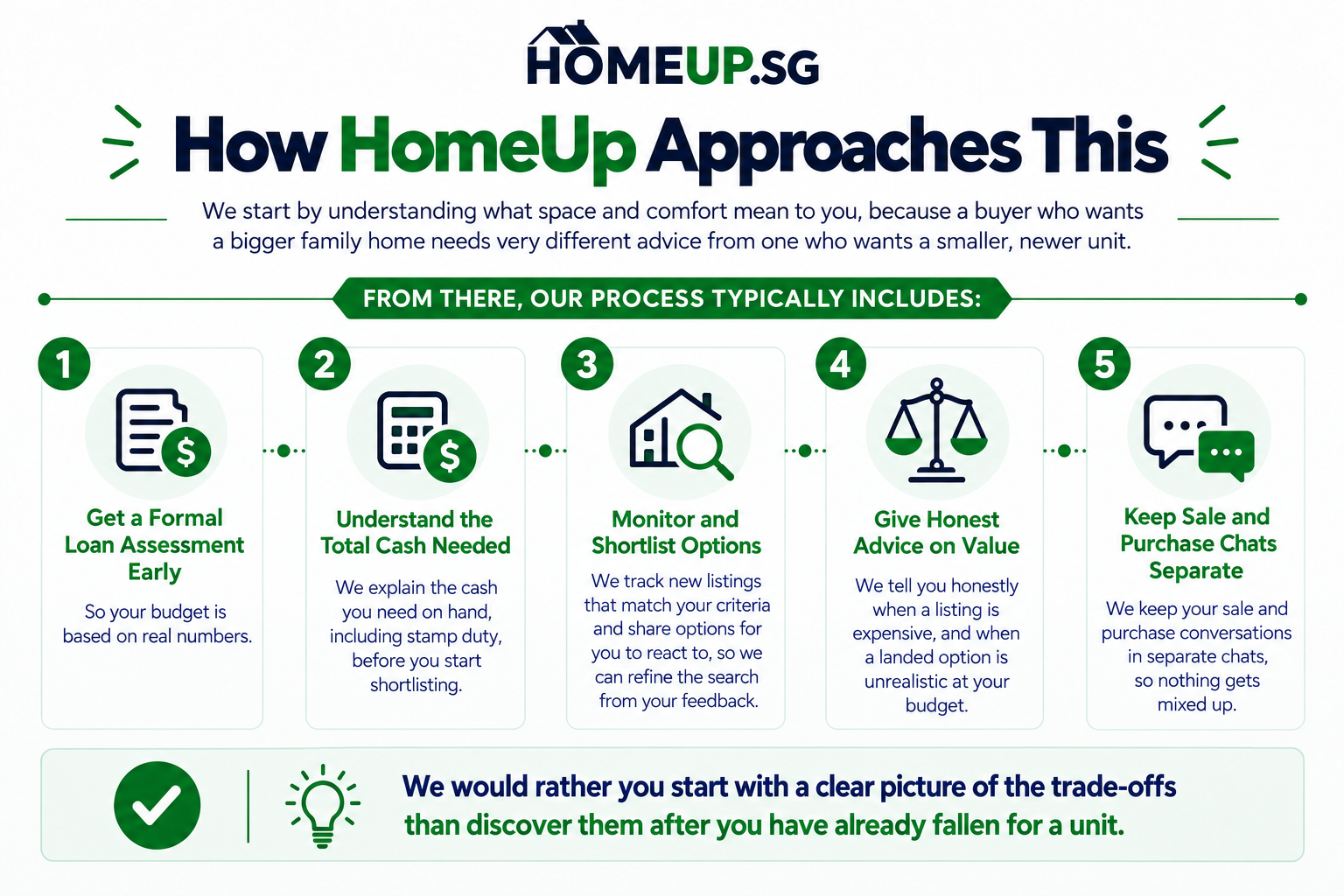
We start by understanding what space and comfort mean to you, because a buyer who wants a bigger family home needs very different advice from one who wants a smaller, newer unit.
From there, our process typically includes:
Getting a formal loan assessment early, so your budget is based on real numbers.
Explaining the cash you need on hand, including stamp duty, before you start shortlisting.
Monitoring new listings against your criteria and sharing options for you to react to, so we can refine the search from your feedback.
Telling you honestly when a listing is expensive, and when a landed option is unrealistic at your budget.
Keeping your sale and purchase conversations in separate chats, so nothing gets mixed up.
We would rather you start with a clear picture of the trade-offs than discover them after you have already fallen for a unit.
Conclusion
There is rarely a perfect answer for a space-first upgrader. A big older condo gives you room but may age. Freehold gives you peace of mind but costs more and takes longer to sell. Landed gives you the most space but is scarce, and the real cost is often higher than it first looks.
The buyers who are happiest are the ones who decided early what they valued most, held enough cash for the surprises, and chose the route that fit where they wanted to end up.
Tong Boon is the Co-Founder of HomeUp, a flat-fee real estate advisory in Singapore. He was featured as an independent property expert on CNA's Open House for his views on the Private Residential Market. He also heads the award-winning Champion Private Buying Division in his Agency.
This article reflects his independent views and is not affiliated with any developer or sales team. Client names have been changed to protect their privacy.
Tong Boon is the Co-Founder of HomeUp #1 Transactor in Singapore | 2025 (Private Resale, Buyer Represented), a flat-fee real estate advisory in Singapore. He was featured as an independent property expert on CNA's Open House for his views on the Private Residential Market. He also heads the award-winning Champion Private Buying Division in his Agency.
This article reflects his independent views and is not affiliated with any developer or sales team. Client names have been changed to protect their privacy.