
Quick Answer
If your condo search has stalled because you are fixed on one unit, here is what I would do:
Protect your leverage. If only one unit will do, you have tied your own hands. More realistic options give you room to negotiate, or to walk away.
Find the need behind each want. A balcony may really mean open space. A size target may really mean a layout that works for your family.
Check the market truth. Look at what has actually sold, not just what is listed. In many projects, prices have been moving up, not down.
Widen your options. Consider other locations near an MRT station, and slightly smaller units with efficient layouts.
Count the cost of waiting. Ask yourself what you will do if nothing comes up in three months, and put numbers on it.
Negotiate and view at the same time. Talk to the seller early, keep viewing other projects, and set a decision date.
Introduction
When a buyer gets stuck, it is rarely because there is nothing to buy. It is usually because there is one specific thing they want.
I recently caught up with a couple who had hit a roadblock. They were looking for about 1,000 square feet, three bedrooms, ideally three toilets, and a balcony, near an MRT, with a firm ceiling of around $2.3 million. They were not in a hurry, because they still had a home to sell. They had even placed a bid on a unit they liked.
Now a unit with the perfect layout had come up at close to $2.4 million. Eight months earlier, they had offered around $2.15 million for the same layout, and it had not worked out. They were now looking at about $200,000 more than they could justify.
They did not need a new project. They needed a way out of being stuck. This is how I approached it.
Why does loving one unit make me a weaker negotiator?
Because the seller's agent can feel it, and you cannot walk away.
If this is the only unit that fits all your criteria, you are tied hand and foot. The seller knows you have nowhere else to go, and you know it too. That makes it hard to hold your price.
I asked this couple a simple question: is it really only these two projects? If it is, you have very little room. If not, you have options. More options mean more room to negotiate. If a seller will not give a fair price, you can choose a good unit somewhere else. Even if you never use that option, knowing you have it changes how you negotiate.
What do I really need, compared with what is on my list?
Look for the need behind each want.
When I asked about the balcony, the answer was simple: it was open space, so they could step outside and talk when the kids were asleep. That is a clear need, and it can sometimes be met by a layout or a feature other than a balcony. A size target works the same way. If I ask whether a 950 square foot unit with an efficient layout would work, the answer tells me whether size is a real need or just a number.
It also helps to sort your must-haves. If you could only keep two out of four requirements, which would they be? Some buyers have never done that exercise, and it makes the search much more flexible.
What does the market actually say about price?
Often something different from what buyers hope.
In the project this couple liked, units that sold over the previous twelve months mostly moved higher, not lower. I told them so directly. The listing at close to $2.4 million felt too high to them, and I understood that. But expecting a big drop in a project like that can be unrealistic. In my experience, buyers who wait for a large fall often end up paying more later. That is not a forecast, but it is why I want buyers to look at what has actually sold instead of focusing only on the asking price.
I also pointed out that some sellers list high but are flexible. Others are stubborn. It depends on the seller, not just the number.
How do I negotiate with a seller who is asking too much?
Start early, and start with facts.
My plan for this couple was to speak to the seller's side first, understand how firm they were, and try to bring the price towards the $2.2 million range. They had already offered about $2.15 million on the same layout, so the gap to the listing was large. That information matters, and it gave us a realistic target.
I also told them that I might walk away at times. Sometimes it helps to step back and return a couple of weeks later, because sellers can become more realistic over time. But that is not guaranteed, so we do not rely on it. We negotiate and view other projects at the same time, so the waiting does not cost us the whole market.
What is waiting costing me?
More than most buyers think.
I ask a straightforward question: if nothing comes up in three months, what will you do? Then I help buyers put numbers on it. For illustration, if prices in your target area rose by even $10,000 a month, three months of waiting would cost $30,000, which is roughly the cost of a good renovation. I am not predicting that prices will rise by that much. I am showing how quickly small movements add up when you stand still.
I have seen buyers with a similar profile wait for several months, only to find that everything had become more expensive. That is why I try to shorten the pain early. I would rather you decide within a defined window than drift for a long time.
How should a consult end?
With next steps and a date.
Every discussion I have with a buyer ends with what happens next and by when. By tomorrow, I will speak to the seller's side. By the end of the week, I will send a few more projects to consider. Over the weekend, you can view them, and I even suggest making it a family outing, because this is your next home. A decision date turns a vague search into a plan.
Practical Framework
When your search stalls, I use a simple checklist I call UNSTUCK:
U: Unpack the brief. Confirm what you want, in your own words, in case anything has changed.
N: Needs behind the wants. Understand why you want each feature, such as a balcony or a certain size.
S: Sort your must-haves. If you could only keep two, which would you choose?
T: Truth from the market. Look at what has actually sold over the last twelve months, not just what is listed.
U: Unlock more options. Consider other locations, projects and slightly smaller units with efficient layouts.
C: Cost of waiting. If nothing comes up in three months, what will you do, and what does it cost?
K: Key next steps. Leave every discussion with actions and a decision date.
How HomeUp Approaches This
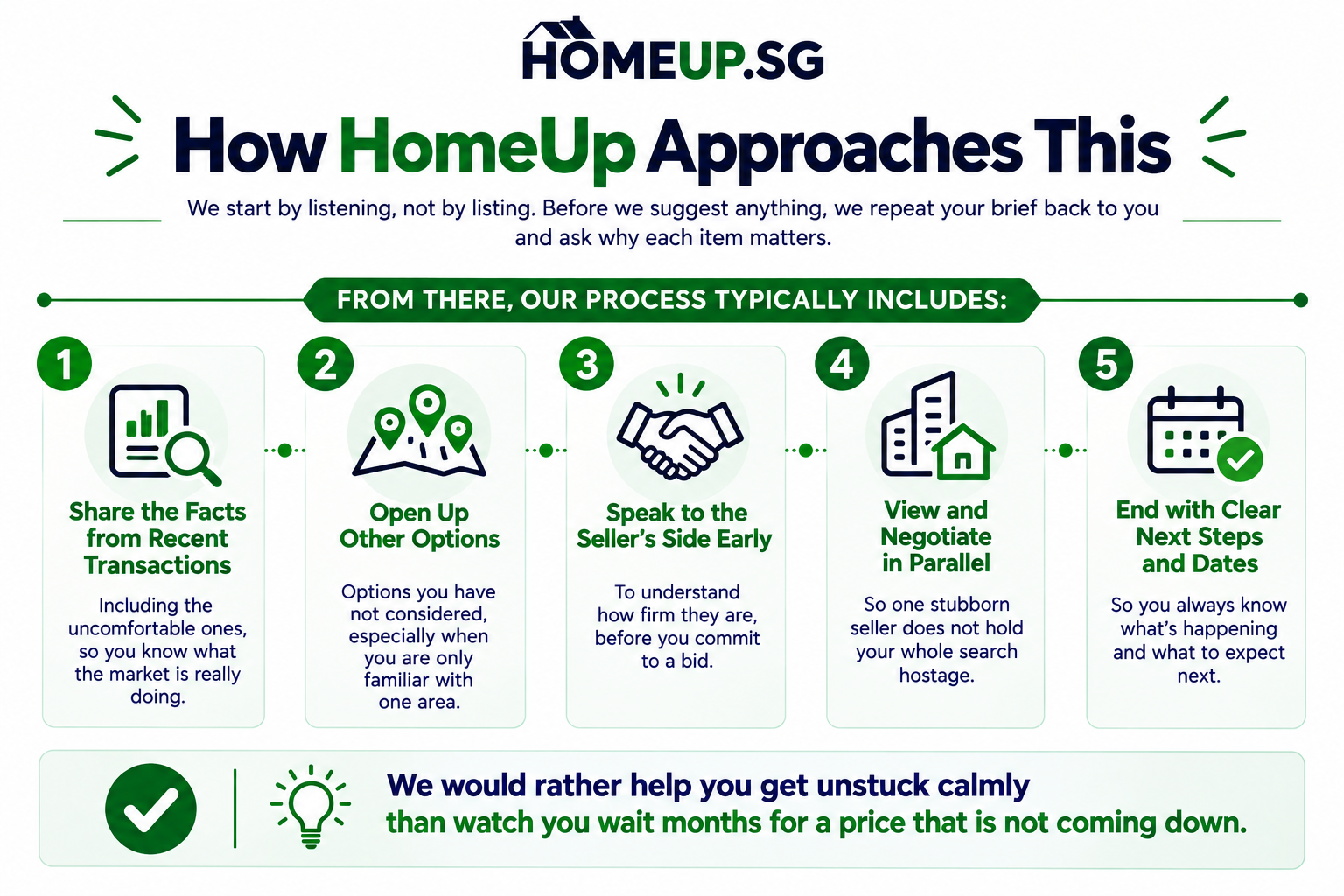
We start by listening, not by listing. Before we suggest anything, we repeat your brief back to you and ask why each item matters.
From there, our process typically includes:
Sharing the facts from recent transactions, including the uncomfortable ones, so you know what the market is really doing.
Opening up options you have not considered, especially when you are only familiar with one area.
Speaking to the seller's side early to understand how firm they are, before you commit to a bid.
Viewing and negotiating in parallel, so one stubborn seller does not hold your whole search hostage.
Ending each conversation with clear next steps and dates.
We would rather help you get unstuck calmly than watch you wait months for a price that is not coming down.
Conclusion
A stalled search is frustrating, but it is usually fixable. The way out is rarely a magic project. It is more options, a clearer view of what you need, honest facts about the market and a plan with dates.
Buyers who regain their options tend to negotiate better, wait less and pay fairer prices. They also feel calmer, because they know they are not tied to a single outcome.
Tong Boon is the Co-Founder of HomeUp, a flat-fee real estate advisory in Singapore. He was featured as an independent property expert on CNA's Open House for his views on the Private Residential Market. He also heads the award-winning Champion Private Buying Division in his Agency.
This article reflects his independent views and is not affiliated with any developer or sales team. Client names have been changed to protect their privacy.