

Quick Answer
When your criteria for a condo don't all fit your budget, work through this order:
Bedroom count first. Three-bedroom is usually the real floor for most families, and four-bedroom units tend to be the easiest to exit later because demand for them is consistently strong.
Layout before raw square footage. A smaller, efficiently laid-out new unit can feel roomier than an older unit with more square footage on paper but wasted corners, bay windows, or planter boxes.
Lease age matters for exit, not just price. Condos 1-10 years old tend to hold buyer interest better than older stock, but going for a very new project usually means less space for the same budget.
Know what kind of help you actually need. Some buyers need help identifying the right property. Others need negotiation muscle or timeline planning. These need different things from an advisor, and it's worth being honest with yourself about which one you are.
There's rarely a project that ticks every box. The buyers who end up happiest are the ones who decide early which box matters least.
Introduction

Most first-time condo buyers come to me with a wish list, and almost none of them have checked whether the list actually fits their budget. That's not a criticism. Nobody expects to be an expert at this before they've done it once.
I recently sat down with a father in his 40s, upgrading from HDB to condo for the first time. His reasons were straightforward: a longer commute after changing jobs, and a daughter about to sit her PSLE, with schooling flexible enough that the property decision could come first. His budget was firm. His bedroom count wasn't quite firm, but close. His preference for a newer, MRT-connected project was strong.
Put those together, and there was really only one type of project left standing. That's the conversation I want to walk through, because it's the same conversation I have with almost every first-time upgrader, just with different numbers.
Why does almost every buyer's wish list conflict with their own budget?
Because most people build their wish list around comfort, not against their numbers.
When I looked at this buyer's criteria against his budget, the math only pointed to one type of project: a genuinely new development along a newer MRT line. Older projects in the same budget range existed, but almost none matched his newness and connectivity preference at the same time.
That's the conflict. It's rarely obvious to buyers until someone puts the numbers next to the wish list. My job at that point isn't to talk anyone out of what they want. It's to show them clearly what has to give.
Is a four-bedroom really worth prioritising over a bigger, cheaper three-bedroom?
For most buyers thinking long-term, yes, if the budget allows it.
I generally point clients toward four-bedroom units when it's within reach, because demand for them holds up unusually well. A meaningful part of that comes down to ABSD: each person can typically only hold one property comfortably from a tax standpoint, so as buyers become more affluent, many choose to buy a bigger single unit rather than juggle multiple smaller ones. That pushes demand toward three- and four-bedroom units specifically.
On the selling side, this shows up clearly. Four-bedroom listings tend to move quickly unless they're significantly overpriced. One- and two-bedroom units are consistently the slowest to sell, largely because the buyer pool for them skews toward individuals rather than families, and that pool simply has less collective purchasing power.
For this buyer, three-bedroom was his real floor, four was the upgrade if the numbers worked. That's actually a healthy way to frame it: know your floor, treat anything above it as a bonus, not a requirement.
Is a smaller new condo actually worse than a bigger older one?
Not necessarily, and this is where buyers surprise themselves most often.
Some older condos look generous on paper but waste a lot of that space in the layout bay windows, planter boxes, awkward corners that don't function as usable room. A unit listed at over 1,300 square feet can genuinely feel smaller in daily use than a well laid-out 1,000 square foot unit in a newer project.
Newer developments tend to be far more efficient with space, precisely because that wasted allowance has mostly been designed out. The trade-off is that newer layouts often look quite similar to each other living room to one side, bedrooms facing across a shared corridor. Efficient, but not always distinctive.
My advice to buyers who see a smaller square footage number and immediately rule it out: view it first. A number on a listing doesn't tell you how a layout actually lives. I've had more than a few clients walk into a sub-1,000 square foot three-bedroom expecting to feel cramped, and walk out surprised at how comfortable it actually felt.
What should buyers figure out before their first viewing, not after?
What kind of help they actually need.
Not every buyer needs the same thing from an advisor. Some genuinely need help identifying the right property, because on their own they don't have a strong read on which locations or projects offer real upside. Others already know what they want and mainly need strong negotiation. Others just need someone to manage a complicated timeline, especially when it involves selling an HDB and buying a condo in the same stretch.
Being honest about which one you are changes how a viewing schedule should even be built. A buyer who needs help identifying the right property benefits from seeing a wider spread of options early, even ones slightly outside the initial wish list, purely to calibrate what "good" actually looks like. A buyer who already knows exactly what they want doesn't need that spread. They need someone focused on getting the best price on the one or two options they've already identified.
Practical Framework
Before your first viewing, work through this:
Set your bedroom floor, not your bedroom wish. Decide the minimum you actually need, and treat anything above it as a nice-to-have rather than a hard requirement.
Weigh layout over raw square footage. Don't rule out a unit purely on the number listed. View it, or at least check the floor plan for wasted corners and awkward shapes.
Understand the lease-age trade-off. Very new projects usually mean less space for your budget. Slightly older stock (but still well within the first decade) often buys you more room without giving up much on future demand.
Identify what you actually need help with. Property selection, negotiation, or timeline planning are three different problems. Know which one is yours.
Expect a trade-off, and decide in advance which criterion you're willing to bend on. Budget, bedroom count, newness, and connectivity rarely all align. Deciding this before viewing saves a lot of second-guessing later.
How HomeUp Approaches This
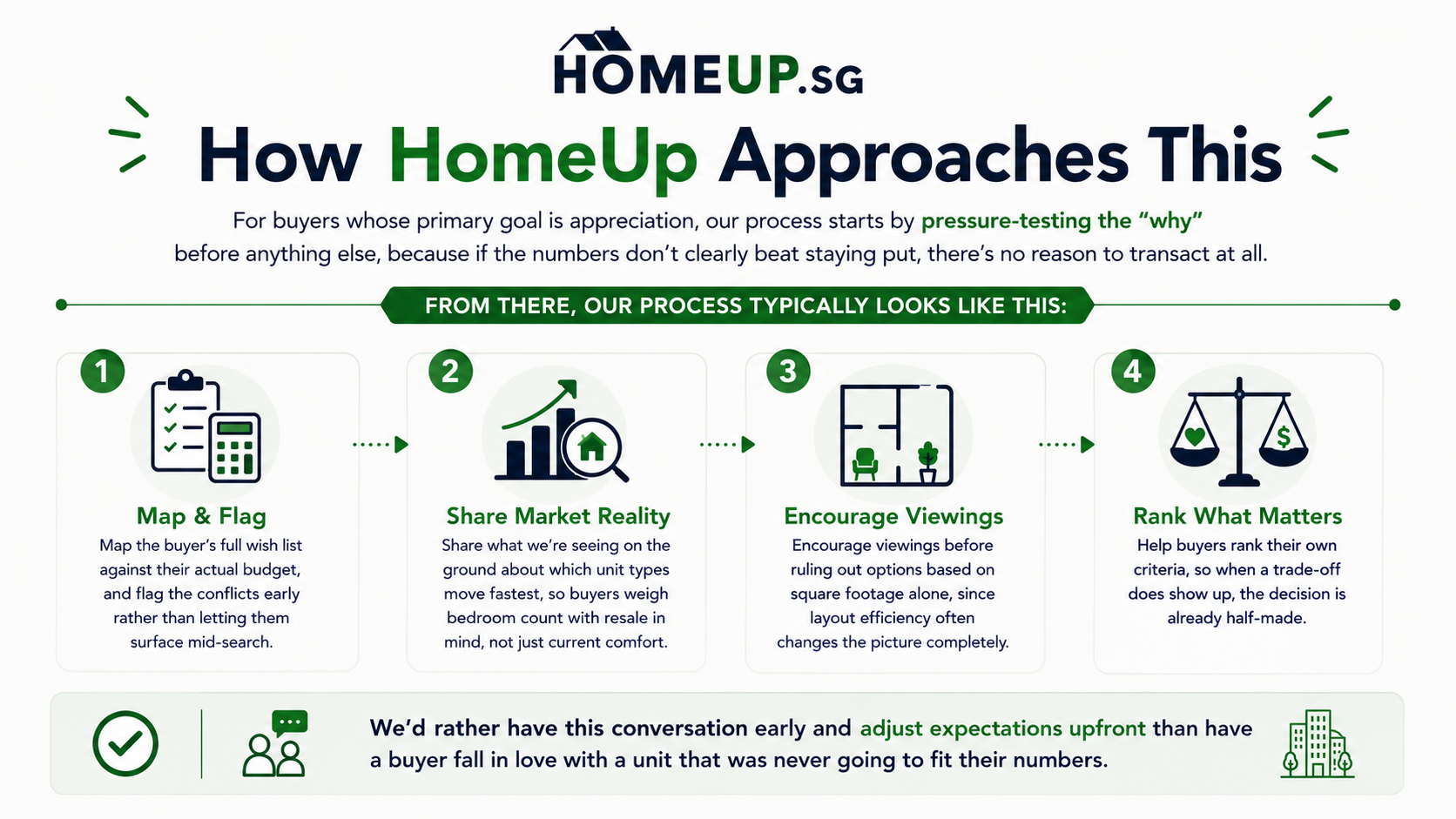
We start by asking what a buyer actually needs help with, because a buyer who needs help identifying the right property and a buyer who already knows what they want require genuinely different support.
From there, our process typically looks like this:
Map the buyer's full wish list against their actual budget, and flag the conflicts early rather than letting them surface mid-search.
Share what we're seeing on the ground about which unit types move fastest, so buyers weigh bedroom count with resale in mind, not just current comfort.
Encourage viewings before ruling out options based on square footage alone, since layout efficiency often changes the picture completely.
Help buyers rank their own criteria, so when a trade-off does show up, the decision is already half-made.
We'd rather have this conversation early and adjust expectations upfront than have a buyer fall in love with a unit that was never going to fit their numbers.
Conclusion
Very few condos check every box on a buyer's wish list, and that's especially true for first-time upgraders who haven't yet had to weigh budget against bedroom count against lease age against location. The goal isn't finding a project that satisfies everything. It's knowing, before you start viewing, which of those criteria you're actually willing to give up on.
Buyers who go in with that clarity tend to make faster, more confident decisions, and end up genuinely happy with what they bought.
Tong Boon is the Co-Founder of HomeUp, a flat-fee real estate advisory in Singapore. He was featured as an independent property expert on CNA's Open House for his views on the Private Residential Market. He also heads the award-winning Champion Private Buying Division in his Agency.
This article reflects his independent views and is not affiliated with any developer or sales team. Client names have been changed to protect their privacy.