
Quick Answer
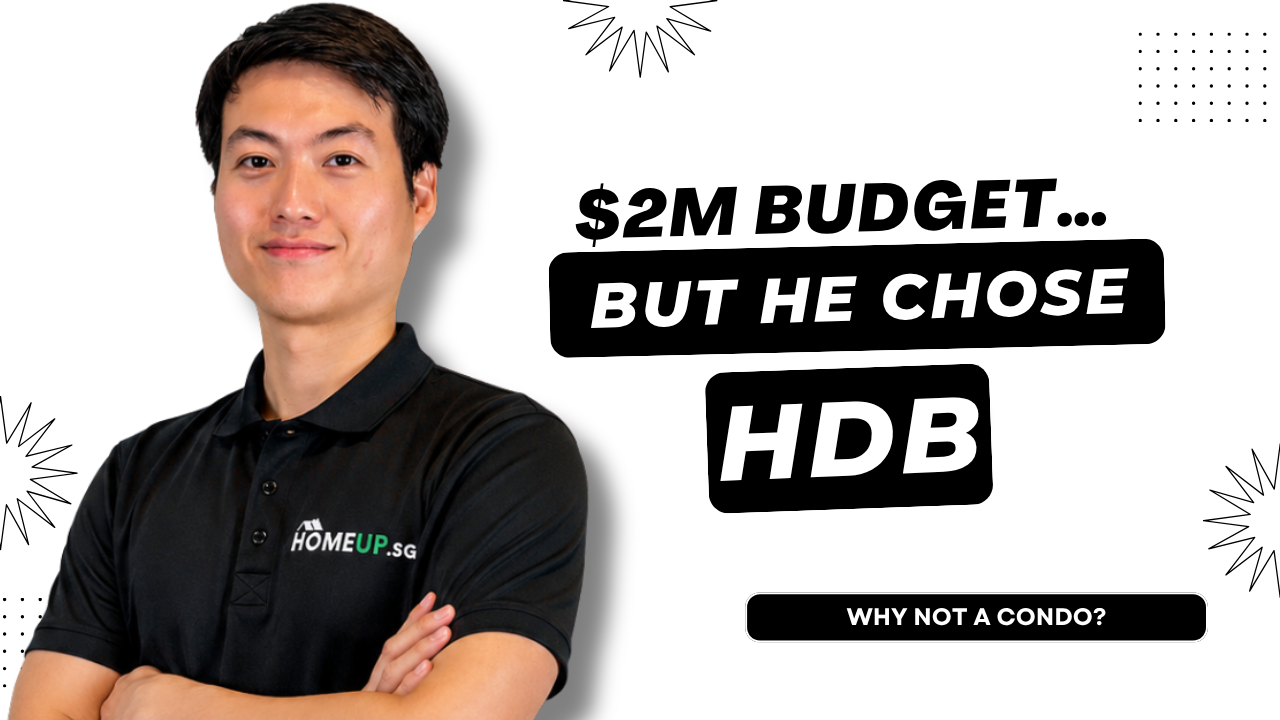
Why Did a Buyer With a $2M Budget Choose a 5-Room HDB Instead of a Condo?
Having a $2 million budget does not automatically mean buying a condo is the better choice.
For this client, the decision came down to cash reserves, job security, investment flexibility, holding period, and future resale demand.
Although he could afford a condo, he and his wife compared the numbers and found that buying a 5-room HDB while keeping more money available for investments made more sense for their situation.
The bigger lesson is simple:
Your maximum budget is not necessarily the amount you should spend.
Introduction
When someone has a budget of around $2 million, the natural assumption is that they should be looking at a private condo.
But one HomeUp client chose a different route.
He works in banking and could stretch to around $2 million. However, after a restructuring in his department, he and his wife became more cautious about taking on a large mortgage.
Instead of simply asking, "What condo can we afford?", they compared two different strategies.
One involved buying a condo, holding it, and eventually selling it after accounting for stamp duties, interest, maintenance fees, and selling costs.
The other involved buying a 5-room HDB and investing the cash they would otherwise have tied up in the condo.
After running the numbers, the HDB plus investment approach came out ahead for their circumstances.
If I can afford a $2M condo, why would I choose an HDB?
Because affordability and suitability are two different things.
A buyer may qualify for a large mortgage but still prefer to keep more cash available.
For this client, the recent restructuring at work made him less comfortable committing a large amount of capital to one property.
The HDB option allowed the family to secure their home while keeping more of their money available for investments.
Should I use as much cash as possible for my downpayment?
Not necessarily.
Putting more cash into the property reduces the loan and monthly instalment, but it also reduces your available cash reserves.
For example, on a 25-year loan at 2.6%, an additional $100,000 downpayment reduces the monthly instalment by about $450.
Keeping that $100,000 in the bank instead could cover approximately 22 months of instalments on a $1 million loan.
The important question is:
How much cash will you have left after buying?
Why does job security matter when choosing between HDB and condo?
Your property decision should not only work when your income is stable.
It should also leave you with enough flexibility if your employment situation changes.
The client had just experienced a departmental restructuring, so taking on a large mortgage required more consideration.
This is why HomeUp looks at both the property and the financial buffer that remains after the purchase.
Can I invest the money instead of putting everything into property?
For this particular client, that was part of the comparison.
The couple considered buying an HDB and putting the cash they would otherwise use for the condo into funds.
This would give them a property for their family's housing needs while keeping some capital in an investment that can generally be accessed more easily than property.
The appropriate approach depends on your own financial circumstances and risk tolerance.
Does the age of an HDB matter if I plan to sell later?
It can matter.
This client planned to stay for at least five to six years because of the children's nearby school. His shortlist included a 5-room flat completed around 2000 and older 5-room flats from the 1990s.
The article's rule of thumb is that if you expect to sell within 10 years, flats completed before 2000 should be considered carefully because older flats can take longer to sell.
However, the trade-off is that newer flats may be smaller while older flats can offer more space for the same budget.
Why did he choose a 5-room HDB instead of a 4-room?
One reason was future supply.
Newer BTO projects around the target area are mostly 4-room flats, meaning a 5-room flat could be less common when he eventually sells.
However, there is a trade-off.
Once an HDB flat goes beyond $1 million, the pool of potential buyers becomes smaller because fewer young couples can afford that price point.
So scarcity can help, but a higher price can also reduce the number of buyers.
Why did he avoid an Executive Maisonette?
The client also considered Executive Maisonettes, but the article highlights several resale considerations.
EMs had strong demand in 2024, but the article describes a different market environment now, with more supply and some units sitting on the market for months.
Age is another consideration. An older EM will have a shorter remaining lease when the owner eventually sells.
For buyers who prioritise space for their own family and intend to stay for a long period, an EM can still serve a housing purpose. But the article advises against relying on it as a property expected to generate a profit.
How HomeUp Approaches This
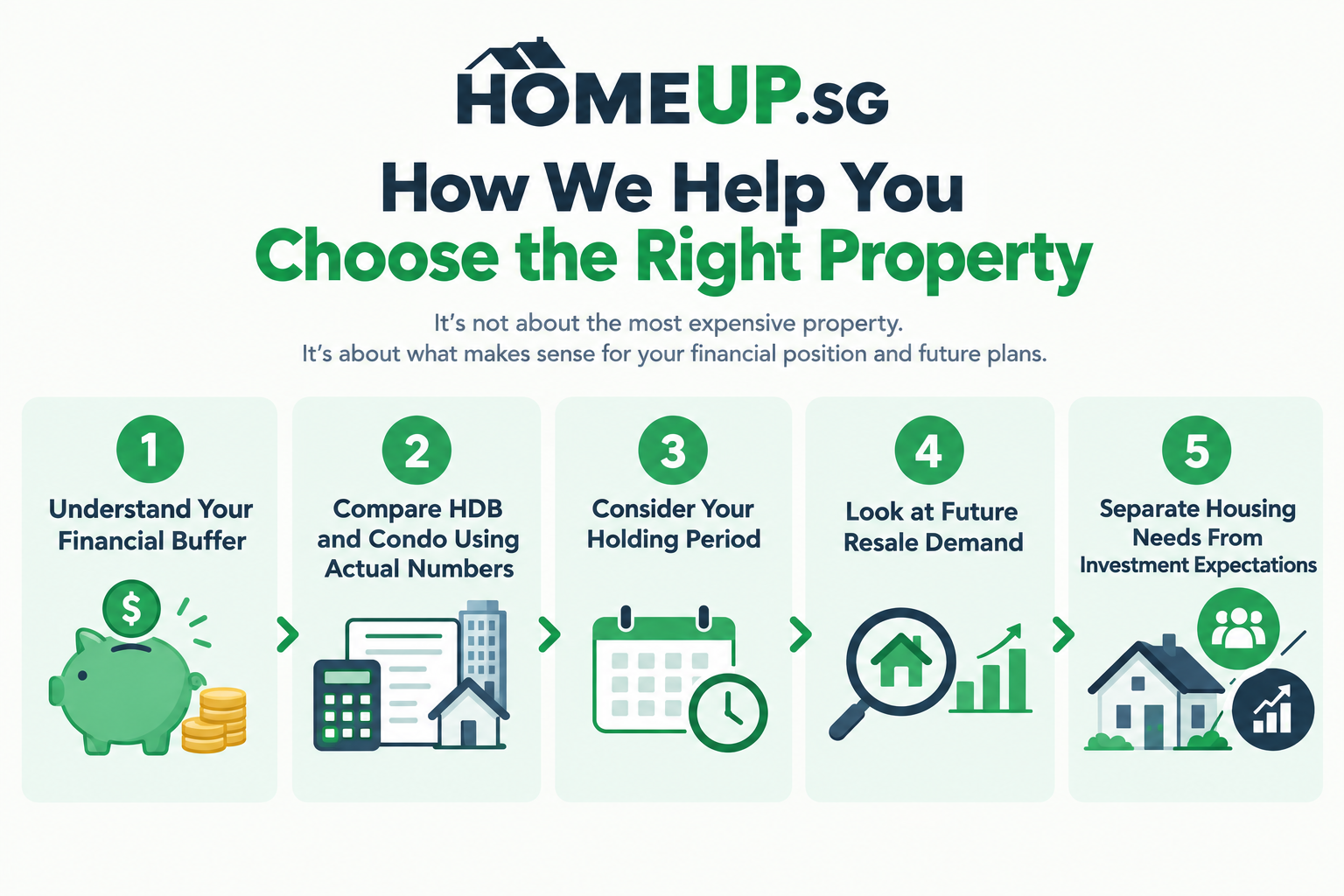
At HomeUp, we do not start with the question:
"What is the most expensive property you can afford?"
We start with:
"What property makes sense for your financial position and future plans?"
Step 1: Understand Your Financial Buffer
Before looking at properties, we consider how much cash you will have left after the purchase.
A smaller loan is not automatically the only goal. Maintaining an appropriate cash reserve can provide flexibility if your income or circumstances change.
Step 2: Compare HDB and Condo Using Actual Numbers
Rather than assuming a condo is automatically the better choice, we compare the potential costs of each option.
This can include:
Downpayment
Mortgage
Interest
Stamp duties
Maintenance fees
Selling costs
Expected holding period
Available investment capital
This was how the client and his wife compared their HDB and condo options.
Step 3: Consider Your Holding Period
The property that makes sense for a five-year plan may be different from one intended to be held for ten years.
For this client, the family expected to stay for at least five to six years because of their children's school.
Step 4: Look at Future Resale Demand
We consider factors such as:
Flat type
Completion year
Location
Future competing supply
Price point
Potential buyer pool
A larger or more unique property is not automatically easier to sell.
For example, a 5-room HDB can benefit from scarcity, but a price above $1 million can also narrow the pool of buyers.
Step 5: Separate Housing Needs From Investment Expectations
Your home needs to work for your family first.
For some buyers, an HDB can provide the space they need while allowing them to keep more capital available elsewhere.
For others, a condo may make more sense.
The objective is to understand the trade-offs before committing.
Conclusion
A $2 million budget does not mean you need to spend $2 million on a condo.
For this client, choosing a 5-room HDB allowed his family to secure the home they wanted while keeping more financial flexibility.
The decision was based on their specific circumstances, including his employment situation, the family's school requirements, their intended holding period, and the opportunity to invest some of the capital elsewhere.
The important lesson is to look beyond the maximum property price you can afford.
The better question is: What property structure gives your family the right balance of home, cash flow, flexibility, and future resale options?
That is where proper planning matters.
Tong Boon is the Co-Founder of HomeUp, a flat-fee real estate advisory in Singapore. He was featured as an independent property expert on CNA's Open House for his views on the Private Residential Market. He also heads the award-winning Champion Private Buying Division in his Agency.
This article reflects his independent views and is not affiliated with any developer or sales team. Client names have been changed to protect their privacy.